Pros: None
Cons: None
The unique value of a Demko original utility blade knife.
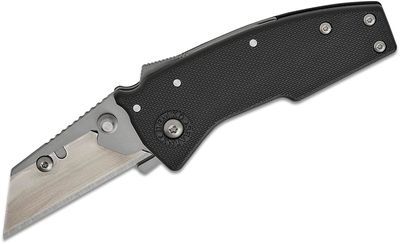
The finish is beautiful, with excellent bead-blasted areas, well-executed clip work, and impressive assembly precision. Overall, it has a very high-quality feel. The opening action has a solid, satisfying click that immediately tells you, “This is a well-made piece.” The Zytel handle has a surface texture reminiscent of G10, giving it a stylish look and a positive impression. As a Demko fan, this was my first time experiencing the Shark-Lock, and paired with the utility blade system, it felt a bit unique. The “shark fin” requires a longer stroke and has more sliding surface than I expected, which means it takes a bit more effort to operate. One-handed use also requires shifting your grip, which feels slightly less convenient. The lock itself seems impressively strong, as expected, but in this configuration, the balance between lock strength and blade retention feels slightly mismatched. The short grip makes it harder to apply force, and even if you do, the blade retention seems to give way before the lock does—so the lock’s full potential isn’t fully realized. That said, this is understandable since the lock was originally designed for standard blades. Additionally, the spine support needed to extend the usable cutting length introduces a slight snag when withdrawing the blade after a cut. This isn’t unique to Demko—many knives with similar structures share this trait—but it’s something you notice in use. Still, Demko’s willingness to experiment with mechanisms and explore new directions remains exciting. As someone who still considers the Tri-Ad Lock the “ultimate practical solution,” trying out a new lock and utility blade concept was a fascinating experience. For urban environments, offices, or desktops—where pulling out a big custom knife would feel excessive—this Demko original offers plenty of value for everyday tasks. I usually use a Milwaukee Fastback Mini, and in pure convenience, that probably wins. But the Demko brings something extra: the “fun” factor. And honestly, isn’t that sense of fun an important part of what makes a tool great?
 (
(