Pros: Construction, Handle Material
Cons: None
Great Hacker. Here's Why
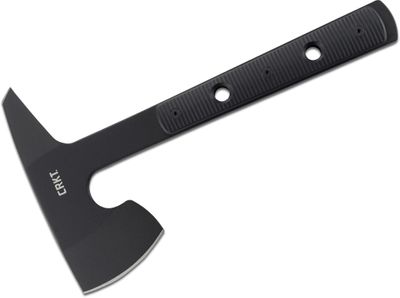
It was a tough choice between the CRKT Jenny Wren and this CRKT Rune Compact, but when the Rune went on sale at Knife Center for half the price, it was mine. Before deciding I noticed that the Jenny Wren was the perfect size, and the green handle color was a good blend for my kit. That noted, a careful review of the details led me to the Rune as the more functional choice. With the reduced price I decided to get the Rune and trim the handle to the same length as the Jenny Wren. Once I got the Rune in hand, I discovered it was a good choice for my planned use. Here’s why. Both CRKT offerings are Taiwanese SK 5 steel, equivalent to about a 1080 carbon steel, and both are equal thickness. Assuming equivalent heat treating they should perform the same. The difference is in how the cutting head is shaped, and in the clearance / distance from the end of the “GRN Nylon” (plastic) handles to the bend merging the shaft and the head. These differences result in: 1) the topmost edges of the head having a 90 degree edge (once the rust proofing is removed) that serve for scraping and ferro rod striking if needed; and 2) the space between the spike / head and the GRN handle may be used to baton the head into wood during kindling processing. (I teach this baton method to my grandkids as a safer method than swinging the hatchet.) Once the rust proofing was removed from the topmost edge of the head, I added some careful “cuts” using my Dremel tool and cutting wheel to make rasp-like teeth between the tapered portions of the cutting end and spike end. These “teeth” serve the same purpose as the teeth formed into the ubiquitous Pilot’s survival knife and work well for notching and similar work. They save a lot of twist and torque stresses on your sharpened edge. I didn’t modify the tapered parts of that top edge because, as mentioned, these were formed with a 90 degree scraping function built in. With those mods done I sharpened the cutting edge. Hair popping, mirror-finished sharpness at completion was just as I’d come to expect with SK 5 based on my experience with the Kabar Heavy Bowie. But, with the Rune’s shape, it’s not nearly as “alarming” as the bowie to any of the weekend wannabe types who show up in my neck of the woods occasionally. And with the few inches of the handle cut from the Rune it weighs only 2 ounces more than the Kabar. An added benefit of cutting off those inches of the handle, to a length about 1 ½ inches below the middle handle fastener, was that the newly cut butt end also serves as a scraping or pounding pommel tool with its own 90 degree edge. The sheath of the Rune, as well as the Jenny Wren, are functional. I plan to improve the retention strap supplied to give a more secure wrap around the entire handle. But, as they are, they would suffice for all but a slip n’ slide tumble down a slope with it attached to your hip belt. I’ll probably paint the sheath in a Ranger Green color using some plastic compatible paint, but that’s just a personal and cosmetic preference. Possible future tweaks include making a custom sheath of Kydex and replacing the GRN Nylon handles with micarta or G10. But, again, both work as is. The Rune isn’t a timber-felling axe, but it’s a great hacker for your belt. That tool, plus a Silky saw or equivalent, plus a small fixed blade like the Kabar/ESEE Escobar can all be hauled without undue strain. With those three, there’s not much you can’t do for a quick or an emergency overnighter (or two or three) in the woods. Kick around what you need, but the Rune is recommended if your needs are like mine.
 (
(