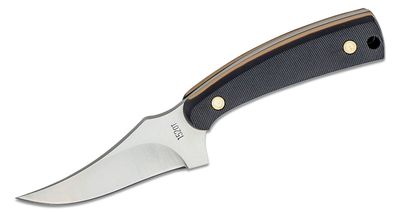
Pros: Weight, Handle Material, Overall Quality, Blade Material, Sheath/Scabbard, Materials, Finish, Blade Sharpness
Cons: None
Blade for Real World Use
Though it is not the 152 Sharpfinger of older days and USA manufacture, the design of the 152OT, 152T, and others numbers given to the camo and the various handle versions now made in Taiwan are all great knives for quick and fine work. I have used the 1095 carbon steel version for years and dealt with the corrosion prevention that is essential. I have two of these older ones, one in the truck kit and one in the motorcycle kit, and have used them frequently over the past 50 years for daily tasks requiring a sharp, precise and nimble blade. When tramping rain forests or fishing coastal waters though I'll swap those for the newer 7CR17 stainless versions that work just as well and are easier to keep clean & bright. Just rinse with fresh water and wipe them dry. No oiling/waxing required. These stainless ones serve like a wash & wear, non-wrinkling shirt in comparison to the 152's older though higher quality button down business shirt that requires ironing after the washing is done. I have the stainless versions from Taiwan too, so I know they work just as well if you know how to use them. They don't hold the edge as long as the older 1095 versions, but they sharpen very quickly. Understand that the Sharpfinger is not going to be used with batons to build an overnight shelter like the bigger Shrade SCHF series . It is not the "One Tool" EOTWAWKI survival blade. But for real world work in the wild places just pack a hatchet along and the Sharpfinger is the only knife you're going to need. It'll make light work of fuzz sticks, delicately slit open skin to surgically remove a deep sliver, and breeze through any fish/game processing. Splitting bones, of course, is one of those tasks reserved for the hatchet you're hauling around. Yeah, maybe a big SCHF can do the bone splitting too. But then, imagine getting that deep splinter out with a big Bowie knife. That wouldn't work out well for most of us. As for sharpening, I keep a razor's edge on stainless and on carbon steel Sharpfingers by setting the edge angle at about 25 degrees and finishing the stainless ones with a simple dog-bone style ceramic triangle hone. For the carbon steel ones I'll finish with a razor strop. The stainless ones, like advertised above, don't need the strop. The stainless ones get hair-shaving sharp with a fine grit ceramic. In response to a previous comment on the factory cutting edge that flattens uselessly as you get close to the hilt/handle end, I agree with the observation. For fine cuts, even slicing a fishing line, the instinctive motion is to cut close to the hilt/handle of the blade. With the factory edge it's like you're trying to cut with the spine of the knife. But it can be fixed with an hour or so of careful filing. A few minutes on the right machine might do it, but I do this stuff by hand, just as if I were off-grid. I've extended the cutting edge all the way to the curve that sweeps down from the spine on all my Sharpfinger models. It makes detailed carving like trap triggers much less work since you get the leverage and control closer to your grip/power point. Cutting rope/twine is instinctive because you can hold the blade in the strong hand, hold the rope/twine in the weak hand, and hook the rope/twine with the thumb of the strong hand as a means to work the rope/twine across the cutting edge. Here's the bottom line: $20 or so for a Sharpfinger as your cutting tool in the real world + $30 or so for a small hatchet as your hacking tool in the real world + $40 or so for your EOTWAWKI SCHF 36/37/38 that stays in the truck until you walk away from its useless carcass, and you've got your bases pretty well covered. And it's a long way from the $300 - $400, or more, that some people spend for their hyped-up One Tool Option. The Sharpfinger works, and works well. But, that's just my opinion. Your call from here.
 (
(