Pros: Effectiveness, Durability, Ease of Use
Cons: Overall Quality
What the …? Has Old Timer Gone Senile?
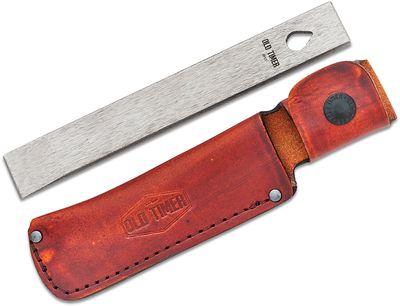
Whoa, Nellie! I see what the problem is, and why many say this thing doesn’t sharpen. Problem is, this thing didn’t know what it wanted to be when it grew up, so it became a bum. Let’s start with a few basic concepts. A “honing steel,” “butcher steel,” is not a knife sharpener. It is used to realign the micro edge on your blade (rolling/chipping), thus prolonging the sharpness of your blade between sharpenings. It doesn’t remove steel from the blade. There are knife sharpeners made of steel. They’re called files, and have UNIFORM sharp ridges cut into hardened steel that remove metal from the blade you’re sharpening. >>>>>>>>>>>>>>> Upon receiving the Old Timer Honesteel I noted that the wide flat surfaces seemed to have been roughed up with a rotary rasp/gouge that had left divots, spikes, gouges, and grooves running length wise of varying depths/sizes (very rough). It didn’t look to me like anything that would sharpen, but, just to see if there were some miracle mechanical principles of physics at play, that I didn’t know about, I took my EDC utility folder that was just starting to dull, and tried sharpening it on the wide flat area of the hone steel. The hone steel completed the dulling process (I imagine further rolling the edge, and taking further small chips from the blade edge). That is what I suspected it would do. Next I tried to use the rounded edge of the hone steel as a proper butcher steel, but found the rotary gouge had not spared the edge of the hone steel, and it was too rough to use as a butcher steel. >>>>>>>>>>>>>>>>>>> So, I took the hone steel to my EZ LAP medium diamond bench stone (#EZL92M, available @ KnifeCenter.com) and tried to smooth out the wide flat surfaces of the hone steel a bit. After a 1/2 hour I discovered that: 1.) The rotary gouge had dug a dip in both sides of the hone steel, so that I would have to remove 1/16” of metal just to get the hone steel flat again, if it ever started that way. 2.) that this was going to be a time consuming project (would go faster on a belt sander). 3.) Hone steel would fall out of the sheath after I had removed all that metal from it. I have opted to just smooth out the edges of the hone steel to use as a butcher steel (1 ½ hrs. estimated time to smooth out edges on bench stone). >>>>>>>>>>>>>>>>>>>>>>>>> Your best butcher steels are smooth (see: Boker German Made Sieger Long Life Ruby Sharpener, Item # BO09SR001, available @ KnifeCenter.com). They prolong the life of an edge between sharpening, therefore, prolonging the life of your knife with less sharpening over its lifetime (less steel removed from the blade). Smith & Sons, and Grossman Knives make nice D2 steel pocket hone steels that are around $60. The Grossman Survival Tool (GST) was featured on pg. 32 of the Sept/Oct issue of Knives Illustrated. It is very similar to this Old Timer Honesteel, but they used a 36-grit ceramic belt to UNIFORMLY texture the flats of the hone steel, so as, to use as a sharpener/file (edges are smooth, to use as butcher steel). I went on BTI, LLC website (parent Company of Old Timer), and found the O.T. Honesteel is 6.20 oz. of A3 tool steel (1.25% carbon). Not a bad steel for the purpose; can be (and seems to be) tempered to 57-62 HRC. If you put in $60 worth of your time on Old Timer Honesteel, you’ll have a nice $25 pocket hone steel w/ $20 sheath. >>>>>>>>>>>>>>>>>> Since there are no instructions included, here is how to use Honesteel once you have smoothed out the edges. HOW TO USE: After several cuts with your sharp knife blade, when you just start to notice the blade dragging, not cutting as well as the first cuts, lightly hone the edge of your blade on the smoothed, rounded edge of the Honesteel with alternating forward/downward strokes. It will realign the micro edge on your blade. The number of cuts you can perform before you need to, “steel,” will vary, depending on the material your cutting, and the type of steel your blade is made of. Cleaning a fish, or cutting cardboard, you may need to steel after just a few cuts. Slicing meat, or cutting rope you may get many more cuts before needing to steel the edge. Keeping a proper angle is essential. Practice at home with the knife you will be honing in the field on a bench stone using the magic marker method, until you can consistently duplicate the proper angle on the steel. Don’t use too much pressure. You’re not trying to remove metal. Once blade is dull you’ll need to re-sharpen, and the hone steel is pretty much useless. >>>>>>>>>>>>>>> The Old Timer Honesteel has a nice 30° double bevel chisel on the end that should work great for splitting kindling/wood for cooking fire, or notching/grooving wood. This will also save steel on your good camp knives. The leather sheath is very nice, too. Although, this hone steel has some drawbacks, once you put some time into it, you will have a nice pocket steel that will save metal on your field knives, and prolong their longevity. And, when you’re field dressing that deer on a frosty November morn, you can take pride in the fact that your knife is staying sharp because of the time and effort you put into this hone steel.
 (
(