 (
(

Pros: Blade Material, Blade Sharpness, Finish, Materials, Overall Quality, Weight
Cons: None
If I could have only one, this would be it
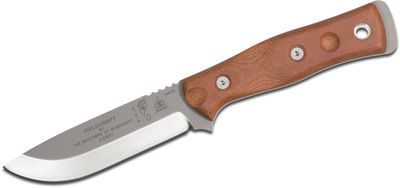
On every fishing, camping, or hunting trip I've ever been on, some version of the following question arises: "If you were stuck on a desert island/in Alaska/on the Lualaba River/etc., with limited kit, what would be in it?" I doubt I'm the only one who's had some variant of this conversation. However, after many years and even more trips, my friends have largely stopped asking which knife I would choose; the answer is always the same: this is the knife I'd want. No doubt there are other very good bushcraft knives available—Fallkniven, ESEE, etc.—but the BROS remains the one I would choose if my life truly depended on it. There isn't one single feature that makes this knife special... There are better knives on the market if what you mostly care about is batoning, skinning, or some other specialized task. But I have yet to find one knife—and I have looked, and looked, and looked—that does EVERYTHING as well as the BROS. And with 10.5 oz. of heft and a 0.190" thick blade, resilience is simply not a concern. A few specific comments: (a) I don't love the Kydex sheath, and I'm even less of a fan of the metal clip. That said, both work well. (In fact, although I hate to admit it, Kydex is probably the most practical choice in most situations.) Of course, TOPS also makes a leather sheath that you can purchase if you prefer. (b) I also own the 1095 version of this knife. While it is an excellent blade in its own right, I prefer this version. The additional corrosion resistance is a real advantage in the field, especially if you are going to be in tropical climes, or any environment where it is seemingly constantly raining or damp. Yes, 154CM is more difficult to sharpen than 1095, but it also holds its edge noticeably longer. For me, that's a tradeoff I'd happily make—especially if this were the one and only knife I could have.
