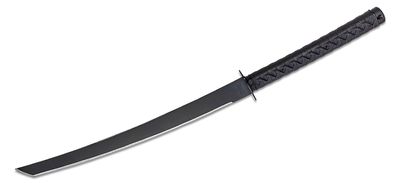
Pros: Overall Quality, Blade Material, Finish
Cons: Handle Material, Sheath/Scabbard
Pretty Good with Some Work - v2.0 Needed
OK, I finally got my hands on this bad boy on August 20th, 2015 after waiting forever since the launch tease. Once Brown put the box in my hands I jumped right to it. Un-boxing found the piece in its sheath inside a plastic bag secured with a folded paper peg hanger label on one end. Very minimalist. Removing the machete (sword) from the over-the-back-mall-ninja sheath is a little tricky since they had to make a cutout in it to allow for the circular metal hand guard to clear. More on this later. In the hand, the blade felt heavy for its length. It's a 35.2 oz, 24" blade with a 12" full tang handle, magnet verified to the butt. The handle is probably the single worst I've ever gripped and using it just confirmed that 10x over. In an attempt to make the machete look mall ninja cool, like it has some kind of traditional wrapping, several ergonomic mistakes were made. The handle is also made of polypropylene, which is very shock transmissive to me. Mind you, I am exactly on the American average for men; 5'9", M-L gloves, so again the ergos on the handles got seriously whacked in the marketing dept. The sharp, protruding 'wrap' features are painful in use, and when combined with the handles width and hardness make it difficult to get a good secure and comfortable grip. As such, when the blade makes contact at anything other than a perfect angle, it tends to twist axially in your hand and jam those little wrap things into you. This hurts, is fatiguing, and dangerous. So, the bad news is form follows function and CS got that part totally backwards, and the handle is polypropylene. The good news is the handle is polypropylene, is reshape-able, you probably have a hack saw or file, and the ergonomics can be corrected in less than an hour. 80% or so in about 10 minutes. I'll tell you what I did below. You will thank me for it. The blade is wide and slightly thicker than most CS machetes (2.8mm vs typical 2.0mm). The edge is much better than other offerings from their South Africa plant. I believe it was sharpened at Ventura, CA...although why after all these years they can't get it right at SA is a mystery. The edge however was still not satisfactory and required minor reprofiling, which vastly improved its performance. Once I lined up my unlimited supply of practice dummies, aka palmettos, palms and scrub oaks, I found that the handle is absolutely abysmal and the edge was in need of work. After just a dozen or so fronds, my hands and wrist ached terribly and only one frond was a one stroke sever one-handed, with the other two being two-handed. All the rest were butcher cuts and very shocky to my hand. I have other CS machetes that fly through this stuff one-handed without any discomfort. i live and work on a park in Florida, so I expect a lot from expensive machetes. Ergo, fail. I was pi**ed. Seriously. After all this waiting. Blade retired for the day to contemplate a return. After sleeping on it, I decided to reprofile the edge with a Presto Eversharp that does a great job on CS machetes and did again. 5 minute job tops. A few passes on both sides put a nice secondary bevel on the edge and a quick steeling smoothed that out afterwards. The secondary bevel allows material to be pushed away from the primary bevel and cuts down on drag and effort...some good oil helps too. The blade has more of a sword balance at only 3.75" from the hilt and the center of percussion was found in a pretty narrow band about 1" wide, 6" from the tip or 4.5" from the tanto angle. Machetes typically are more blade heavy and forward, this is a sword. These data helped radically improve the cuts during testing the next morning. I love 1055 spring steel blades, but the price is paid in harmonics that have to be managed. Finding the center of percussion allows for striking at the point where the harmonics are least with the primary hand in grip position. This made for another vast improvement in cutting and shock transmission. The trifecta was when I decided to take a hacksaw and fix the handle into something more comfortable, ergonomic, and actually useable. Here's how I did it and some tips learned on the way: Get a hacksaw and a block of wood and go outside or in the garage; you're about to make a mess of tiny chips. Now, with the point of the blade in a block of wood on the ground and the butt anchored by your sternum, saw off the wrap protrusions until flush with the side of the handle. This takes a few minutes and makes a world of difference. Now, with gloved hands, grip the sword as you would to use it...tightly, just like you were about to make contact. Note anywhere you have an uncomfortable pressure point, note its location and with the same technique, use the hacksaw now as a rasp and remove just a little material at a time to make the handle more comfortable. It helps to actually take some swings at material to see if any little chafe points show up, if so, then rasp a little more until both hands are comfortable and secure. Once these three things were done, the machete became a useable sword and using sword technique, I began cutting fronds like they were made out of butter. Single handed, two handed, off handed...we're good. Little to no hand shock or twisting and much less effort for the work done. So why 4-stars: It's kind of a sword and kind of a machete, but not really great at either. For about the same money, you can get a fit-for-purpose carbon steel sword of this style that will handle better and have a better handle. However, if buying swords for some 'apocalyptic' scenario, 600 year old designs would rank low. For machete work, I would pick it last of the ones I already own. It's just too heavy for the volume of work I do. I can get two CS machetes that work faster with less effort for the price. Then there's the whole handle and useless over-the-back sheath business. So, all-in-all I got a neat project beater WaKatana-chete for a couple of Jacksons. I'm good, but probably wouldn't do it over again.
 (
(