Can Anything Beat the Cold Steel Recon 1?
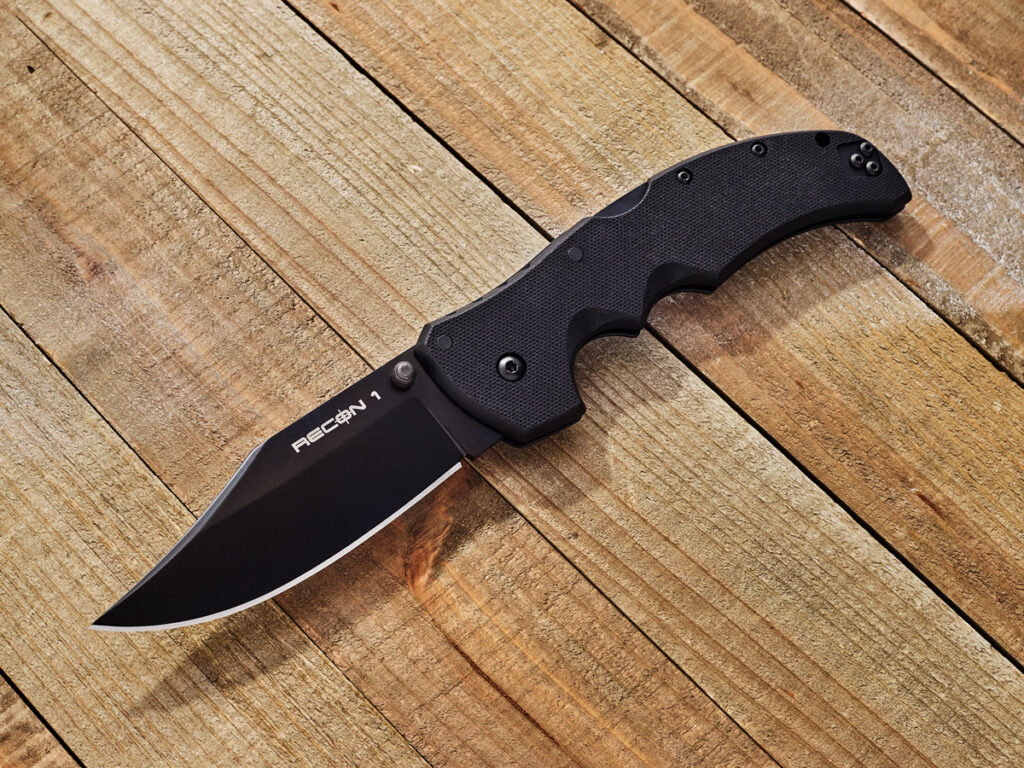
Some knives feel like they were made to be admired. Not so for the Cold Steel Recon 1. This legendary folder was made to get used, hard. It’s tactical yet practical; vicious, but honest.
Whether you’re in law enforcement or military, or you simply want a big, overbuilt folder that’s still easy to carry and slices well, the Recon 1 has a long track record for a reason. It’s not trendy, it’s not pocket jewelry, and it doesn’t try to be fashionable. It’s a blue-collar workhorse, and at this point, it’s an icon.
Why the Cold Steel Recon 1 still earns its reputation
The Recon 1 has been around long enough that many people know of it, even if they haven’t carried one. The current models look a bit different than early versions, but the core idea hasn’t changed: a folder built to take a beating, lock up with confidence, carry flatter than you’d expect, and still cut like a working knife should.
One reason the Recon 1 keeps showing up in “best of” lists is that it offers three blade shapes that cover most needs without changing the overall feel of the knife. You can pick what fits your use and your preferences:
- Clip point
- Tanto
- Drop point
All three options are available in the standard configuration, and it’s easy to understand why someone might want more than one shape over time. If you want to see the current lineup, start with the Cold Steel Recon 1 product page.
Blade specs and pricing (the “sweet spot” configuration)
Cold Steel offers a higher-end MagnaCut version, but the model that sets the value benchmark is the S35VN version. It hits a pricing and performance balance that’s hard to ignore.
| Spec | Cold Steel Recon 1 (S35VN) |
|---|---|
| Blade length | 4 inches |
| Steel | CPM S35VN |
| Handle | G10 |
| Lock | Tri-Ad lock (lockback style) |
| Country of origin | Taiwan |
| Price mentioned | About $127 |
S35VN is the focus here because it’s strong in real-world use, holds an edge well, and doesn’t push the price into the “think about it for a week” zone. MagnaCut is excellent steel, but whether it’s worth more than double the cost depends on your priorities.
The Tri-Ad lock: why it’s more than “just a lockback”
A huge part of the Recon 1’s appeal is the Tri-Ad lock, designed by Andrew Demko. On the outside, it looks like a classic lockback, the kind people have trusted for decades (think of knives like the Buck 110). The difference is what’s going on inside.
The Tri-Ad system uses a stop pin and altered geometry so the lock better resists force from different directions. It’s also designed to self-adjust as parts wear in. That matters because traditional lockbacks can develop blade play after years of hard use. The Tri-Ad lock is built to stay tight longer.
Carry and ergonomics: big knife, flatter carry
For a sturdy 4-inch folder, the Recon 1 carries surprisingly well. The G10 handle scales sit fairly flat, so it doesn’t feel like a brick sticking out of your pocket. It is wide in-pocket, but the overall carry feel stays manageable for the size.
In hand, the standard grip position angles the blade so the tip points a little more naturally forward, which matches the knife’s tactical roots. There’s also room to choke up for more controlled work when you need finer cuts.
Cold Steel Voyager: the “half-price Recon 1” in spirit
The toughest competition for the Recon 1 might be sitting in Cold Steel’s own catalog. The Voyager series hits many of the same notes: big, capable, easy to carry for its size, and built with working intentions. It just lands at a lower tier in materials and price.
The Voyager shown is about $60, and the steel called out is AUS-10 stainless (often said as “AUS-10”). It’s not a powder metallurgy steel like S35VN, but it tends to outperform what many people expect at this price. If you want to compare versions, here’s the Cold Steel Voyager series page.
The main “cost saver” is the handle. Instead of G10, the Voyager uses an injection-molded handle. It’s a bit thicker, and some hands may even find it more comfortable during longer cutting sessions.
What makes it feel Recon-like is that it keeps the same practical grip idea:
- A standard grip that angles the blade down slightly
- A choke-up area for more detailed work
- The same three blade shapes (clip point, tanto, drop point)
In side-by-side comparisons, the Voyager can even show slightly better slicing geometry in some versions (depending on blade shape). If you want a tough large folder on a tighter budget, the Voyager makes a strong case without trying to be anything it isn’t.
Traditional lockback alternatives: sturdy builds with steel trade-offs
Since the Tri-Ad lock is such a big part of the Recon 1’s identity, it makes sense to look at other lockback-style knives. The problem is that true “tactical lockbacks” are not as common as they used to be, at least in the same size and vibe.
Victorinox Swiss Army Evoke
The closest lockback-style competitor on the table is the Victorinox Swiss Army Evoke, priced around $120. It has aluminum handles that feel very solid in hand, arguably even more so than the Recon 1’s G10 in pure “stoutness” feel. Blade length is in the same neighborhood too.
The compromise is the steel. The Evoke uses Victorinox’s standard stainless (an entry-level steel compared to S35VN). The blade is thinner, but it’s paired with a robust grind that helps it keep some toughness. Still, you shouldn’t expect the same edge retention you get from S35VN.
Buck 110 (honorable mention)
The classic Buck 110 Folding Hunter gets a nod because it’s the lockback most people know. In this matchup, it’s simply a bit small to be a true Recon 1 alternative, especially for buyers who want that 4-inch, hard-use folder feel.
Liner lock competitors (and how they try to close the strength gap)
Liner locks are everywhere because they work, they’re simple, and they allow easy one-hand closing. The catch is reputation: a liner lock doesn’t carry the same “built for decades of abuse” story that the Tri-Ad lock does. That doesn’t make liner locks bad, it just changes what people trust them for.
Spyderco Resilience: surprisingly close on price and steel
The S35VN version of the Spyderco Resilience sits around $130 and comes with a 4.2-inch blade. That’s immediately interesting because it’s almost the same money as a Recon 1, and you get more sharpened edge length plus a more efficient slicing profile.
The Resilience feels like a smarter cutter, while the Recon 1 leans more toward brute confidence in geometry and lock strength. Comparing drop point to drop point, the Recon looks and feels a bit more robust. The Spyderco’s handle approach also differs. Instead of two “defined” handholds, it’s a longer handle that lets you slide forward or back as needed.
Grip is a highlight here. The injection-molded handle uses Spyderco’s bi-directional texturing, which gives excellent traction. Finger guard protection is less pronounced than on the Recon 1, which may matter if you’re buying for more tactical-minded use.
If you’re considering the Resilience platform on a budget, there are also 8Cr steel versions mentioned in the video:
- Injection-molded versions start around $72
- A G10 version starts around $77
Is the Resilience a worthy Recon 1 competitor for your use? It’s a great comment-section debate because it comes down to what you value more, slicing and ergonomics, or lock design and “overbuilt” feel.
Viper Safe: a liner lock with an extra lock built in
The Viper Safe is an Italian-made alternative with M390 steel and a 3.75-inch blade. It’s smaller than the Recon 1, but the sharpened edge length stays closer than you might expect thanks to a tidy, space-efficient handle.
M390 gives you a jump in edge retention, while S35VN keeps an edge in toughness. The Viper’s grind stays robust enough that it still feels ready for hard work. Handle options include micarta, and wood versions were mentioned starting around $168.
The key feature is the Safe lock system. It’s a liner lock with a spring-loaded pin that blocks the liner from moving until you intentionally pull down on a textured section. In use, it adds confidence without turning the knife into a puzzle.
CRKT M16: AutoLAWKS and Deadbolt options
The CRKT M16 series has long been a “classic tactical folder” line, and it shows up here because it offers two different paths to added lock security.
One option uses CRKT’s AutoLAWKS system, a secondary safety that engages when the knife opens and helps prevent the liner from being pushed out of place until you disengage it. The example discussed was around $85 and used AUS-8 steel. It can take practice to run smoothly one-handed, but it gives you that “locks on locks” feel.
Another M16 variant uses CRKT’s Deadbolt lock, a design that ranks high in perceived lock strength and durability. The Deadbolt works through the pivot and uses two pins that pass through the blade tang. The example discussed was around $145 with D2 tool steel and aluminum handles. Both M16s mentioned are assisted openers, which gives a faster action than a traditional lockback setup.
Button locks, frame locks, and crossbar locks worth cross-shopping
Once you step away from liner locks and lockbacks, the field gets wider. Some knives chase strength with different lock types, others focus on safety features, and many raise the price quickly, especially when they’re US-made.
Hogue EX-01: button lock with a real safety switch
The Hogue EX-01 is a US-made 4-inch folder priced around $198. It uses 154CM blade steel and matte-finished aluminum handles that feel very solid in hand. The lock is a plunge-style button lock, and it includes a secondary safety switch that can help prevent accidental disengagement during rough work.
It opens manually with thumb studs, and it’s set up for tip-down carry. If tip-down is your preference for a tactical folder, the EX-01 is one of the clearer options mentioned that supports that style out of the box.
Real Steel Evolution Ironclad: budget frame lock with extra safety
For a low-cost alternative that still carries some of the Recon 1’s “hard-use folder” feel, the Real Steel Evolution Ironclad stands out. It was called out as one of the budgetiest alternatives outside the Voyager line, sitting around $64.
It comes in D2 tool steel, with blade shapes described as tanto or a modified clip point. It’s smaller than the Recon 1 in actual edge length, partly because it uses a large finger choil that creates a clear choke-up position. That adds control, but it trades away cutting edge.
The lock is a frame lock with a design feature that adds stability in one direction, plus a button-actuated setup with a secondary safety. That button also allows a more finger-safe closing action. Like the Recon 1, it carries fairly flat but takes up some pocket width.
Crossbar-style locks: fast action, different long-term feel
Crossbar locks are known for strength and easy one-hand operation, but the Tri-Ad lock’s simple, stout layout still has a strong reputation for long-term reliability.
The SOG Trident AT brings a crossbar-style lock, assisted opening, and a unique closed-position safety that helps prevent accidental opening in the pocket. It also adds features some users want on a duty-style knife: a strap-cutter cutout in the handle and a glass breaker. It uses D2 steel and was priced just under $100.
If you want a US-made crossbar-style option, the Benchmade Presidio II was discussed around $250. It uses S30V steel and CF-Elite (a carbon fiber reinforced nylon) to keep weight down while staying strong, supported by full-length liners. It feels a bit smaller than the Recon 1, but still sits in the “big folder that can do smaller tasks” category.
Another US-made option mentioned is the Zero Tolerance 0203, with a 4-inch blade in M4 steel and a very smooth crossbar-style action. It matches the Recon 1 in general vibe and comfort, but it sits in a higher price tier.
Spyderco Manix 2 XL and the final verdict on value
From Spyderco’s lineup, the knife that felt most like a true Recon 1 competitor was the Spyderco Manix 2 XL, even more than models like the Spyderco Military 2 that were also considered.
The Manix 2 XL uses Spyderco’s Ball Bearing Lock, which operates a lot like a crossbar lock in the hand, but uses a coil spring that pushes a ceramic ball bearing into the blade tang. It’s widely respected as a strong, reliable mechanism.
The example discussed used Spy27 steel, Spyderco’s proprietary steel with good toughness. An S30V version is also available if you want a more traditional steel and handle color than the cobalt blue shown in the video. Ergonomically, it echoes the Recon 1 in a key way: you get a standard grip that angles the blade downward a bit, plus a clear choke-up spot with Spyderco’s guarded finger choil for more controlled work.
Geometry-wise, it balances durability and cutting. The blade stock may be thinner than some other large Spydercos, but the tip area feels stout, and the higher grind should help with slicing efficiency.
Price, steel, and lock comparison at a glance
Here’s the basic value argument in table form. Prices are the ones discussed in the video.
| Knife | Price mentioned | Steel mentioned | Lock type | Link |
|---|---|---|---|---|
| Cold Steel Recon 1 | About $127 | S35VN | Tri-Ad lock | Cold Steel Recon 1 lineup |
| Cold Steel Voyager | About $60 | AUS-10 stainless | Lockback style (Tri-Ad family) | Cold Steel Voyager series |
| Victorinox Evoke | About $120 | Victorinox stainless | Lockback | Victorinox Swiss Army Evoke |
| Spyderco Resilience (S35VN) | About $130+ | S35VN | Liner lock | Spyderco Resilience options |
| Viper Safe | About $168+ (wood) | M390 | Safe liner lock | Viper Safe configurations |
| CRKT M16 (AutoLAWKS) | About $85 | AUS-8 | Liner lock with safety | CRKT M16 lineup |
| Hogue EX-01 | About $198 | 154CM | Button lock with safety | Hogue EX-01 variations |
| Real Steel Evolution Ironclad | About $64 | D2 | Frame lock with safety | Real Steel Evolution Ironclad |
| SOG Trident AT | Under $100 | D2 | Crossbar-style, assisted | SOG Trident AT models |
| Benchmade Presidio II | About $250 | S30V | Crossbar-style | Benchmade Presidio II |
| Zero Tolerance 0203 | Higher-priced US-made | M4 | Crossbar-style | Zero Tolerance 0203 |
| Spyderco Manix 2 XL | Around $250 | Spy27 (S30V also available) | Ball Bearing Lock | Spyderco Manix 2 XL |
The pattern is clear: plenty of knives compete on size and intent, some compete on steel, and some compete on lock strength. Very few compete on all of it at once, at the Recon 1’s price.
If you want to keep browsing beyond this matchup, KnifeCenter also links their full KnifeCenter catalog, plus a KnifeREWARDS sign-up page and their email newsletter signup.
Conclusion
If the goal is a big folder that feels overbuilt, carries flatter than expected, and comes with a lock built for the long haul, the Cold Steel Recon 1 still sets a hard standard at about $127. Many alternatives bring great features, smoother actions, or US-made appeal, but they usually ask you to give up something, often price, steel, or long-term lock confidence. If you’ve carried any of these side-by-side, share which one you think can truly challenge the Recon 1, and what mattered most to you, steel, lock, carry, or cutting feel.