Description
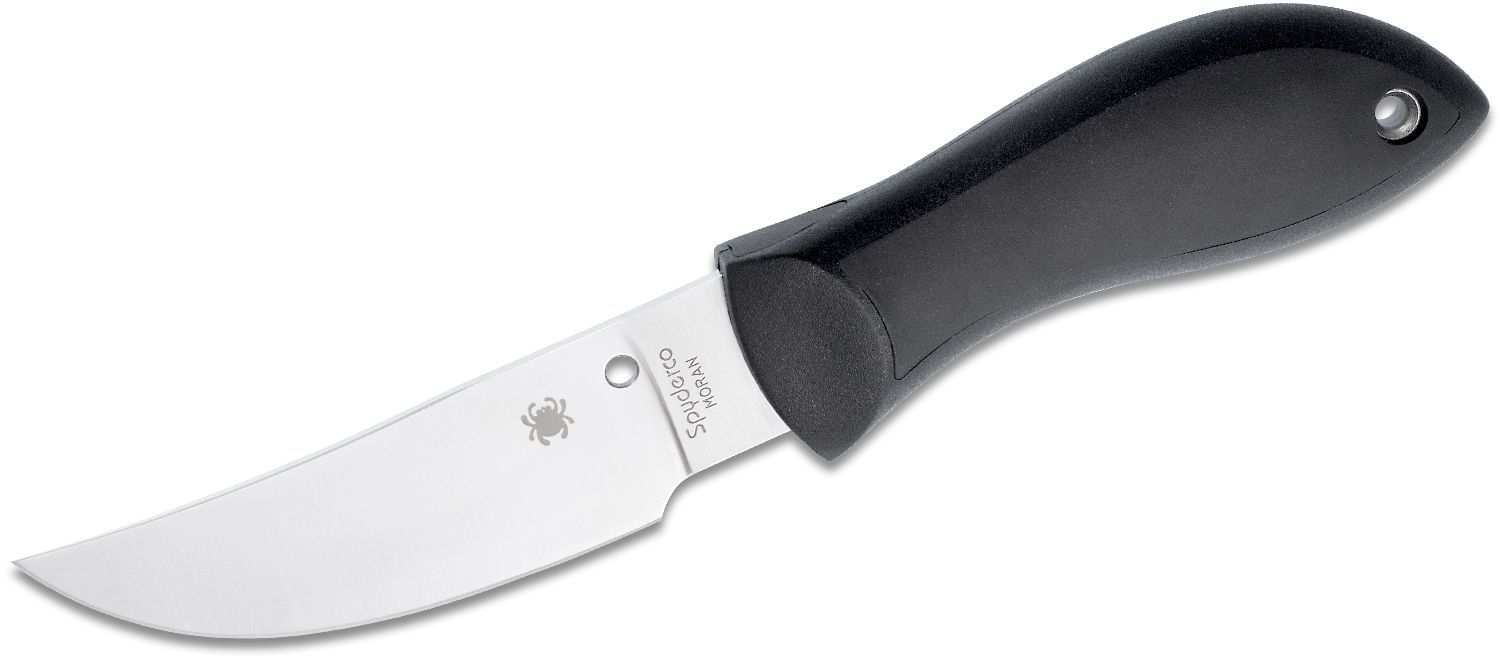
SPFB01: FB01 Bill Moran Bowie
Spyderco Knives
William Francis Moran Jr., better known as Bill Moran, was an extremely influential figure in the world of custom knifemaking. One of America's premier custom bladesmiths, he was instrumental in the rediscovery of the art of forging pattern-welded, or Damascus, steel. His iconic “Featherlight” design was also the basis for Spyderco's very first, and most enduring, fixed-blade production models.
Bill Moran was born on May 1, 1925, on a dairy farm near Lime Kiln, Maryland. He learned the art of blacksmithing by trial and error using an old coal forge he found on his family's property. He forged his first knife at the tender age of 12 and within two years was making knives to sell. By the 1950s, Moran was publishing a catalog of his knives and developing a devoted following as one of America's few true bladesmiths. In 1960, his reputation as a knifemaker had grown to the point that he finally sold the family farm and devoted himself full time to his craft.
Moran was fascinated by pattern-welded steel and throughout the 1960s focused intently on rediscovering the secrets of this lost art. In 1972, he was elected chairman of the Knifemakers' Guild and one year later unveiled eight of his Damascus-bladed knives at the Guild Show. The breathtaking craftsmanship of those knives took the knifemaking community by storm and ignited modern interest in Damascus steel.
In 1976, Moran, along with renowned author B.R. Hughes and fellow bladesmith pioneers Bill Bagwell and Don Hastings, founded the American Bladesmith Society (ABS). Dedicated to preserving and promoting the craft of the hand-forged blade through education, testing and certification, the ABS continues to be the leading force in the bladesmith's art today and has members on six continents.
Moran was inducted into BLADE magazine's prestigious Cutlery Hall of Fame in 1986 and two years later helped the ABS found a Bladesmithing School on the grounds of Historic Washington State Park in Hempstead County, Arkansas. Auspiciously, the school's location is near where many historians believe James Black crafted Jim Bowie's legendary Bowie Knife sometime in the 1820s. A collaborative effort of the ABS, the Pioneer Washington Restoration Foundation, Arkansas State Parks, and Texarkana College, the school was officially renamed the William F. Moran School of Bladesmithing following Moran's retirement from teaching in 2001.
Bill Moran died of cancer on February 12, 2006. Today, he is fondly remembered as the driving force in rediscovering the art of pattern-welded steel and one of the world's most influential figures in popularizing hand-forged knives.
Spyderco's Moran Models
In 1985, Spyderco co-founder Sal Glesser participated in the first ABS “hammer-in” at the University of Wyoming in Dubois Lakes. At that landmark event, Sal not only learned to forge blades under the expert tutelage of the ABS' creators, he also developed a close friendship with Moran. That friendship led to discussions of a design collaboration and, ultimately, to Spyderco's first fixed-blade model, the FB01.
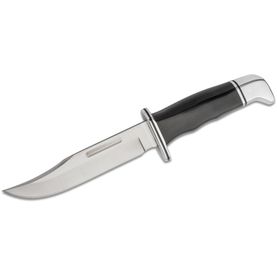
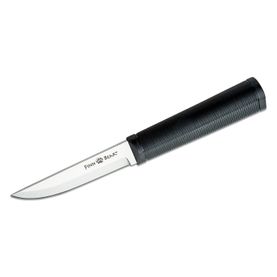
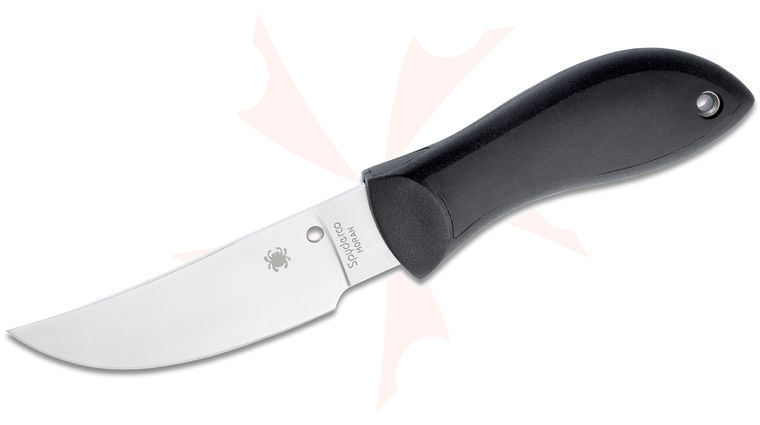
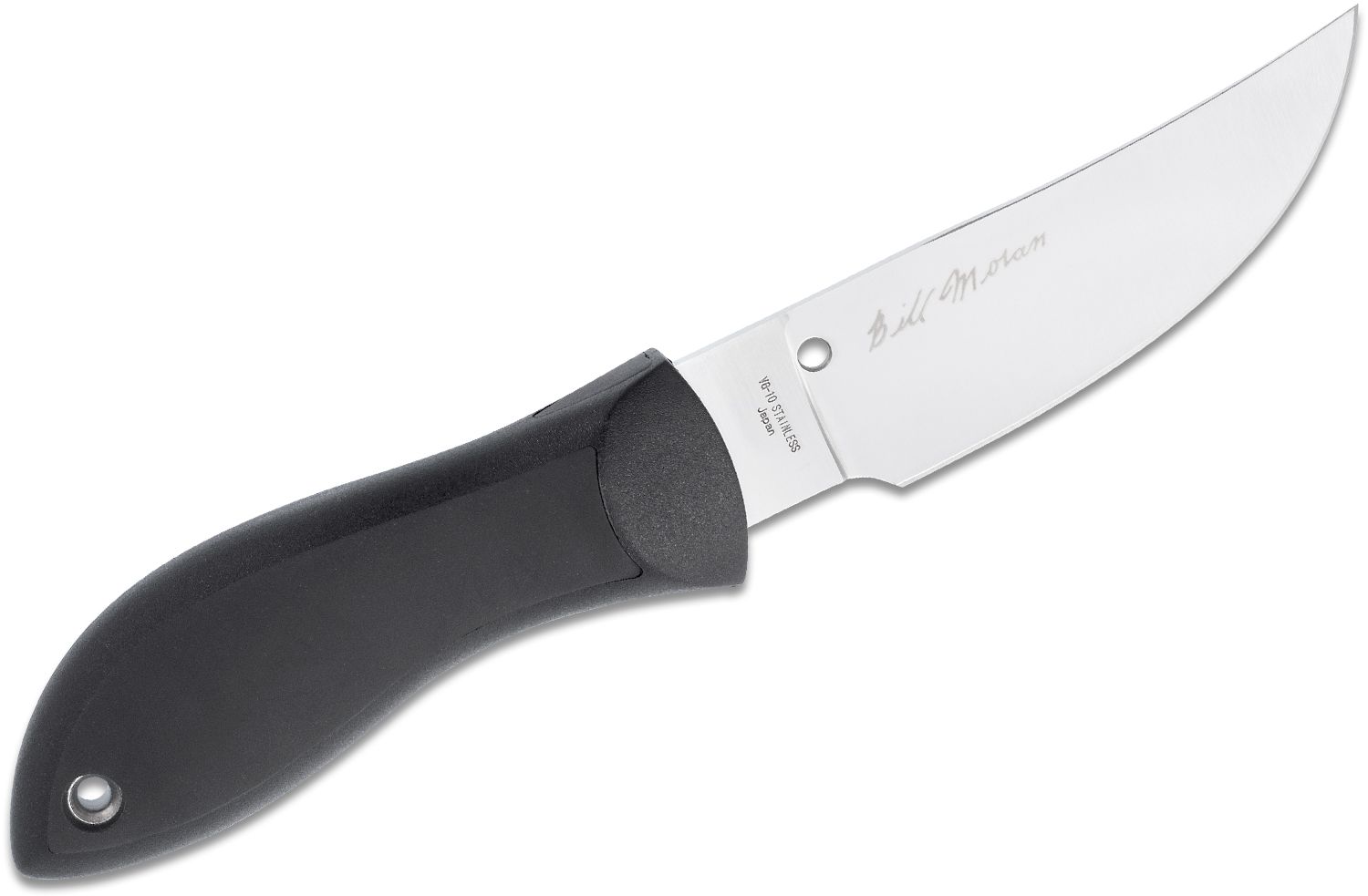
Released in 1995, the FB01 was originally named the Bill Moran Featherweight after Moran's custom Featherlight pattern, which inspired it. Custom Featherlights featured ergonomic, pear-shaped handles typically crafted from curly maple and often embellished with decorative carving and wire inlays. The FB01 faithfully replicated the Featherlight's distinctive handle shape and paired it with a gracefully curved, trailing-point blade. The blade was crafted from highly polished VG-10 stainless steel and, very uniquely, was sharpened with Moran's signature convex, or “appleseed” edge. Later, the Moran edge was discontinued in favor of a conventional edge bevel that was easier for end users to sharpen.
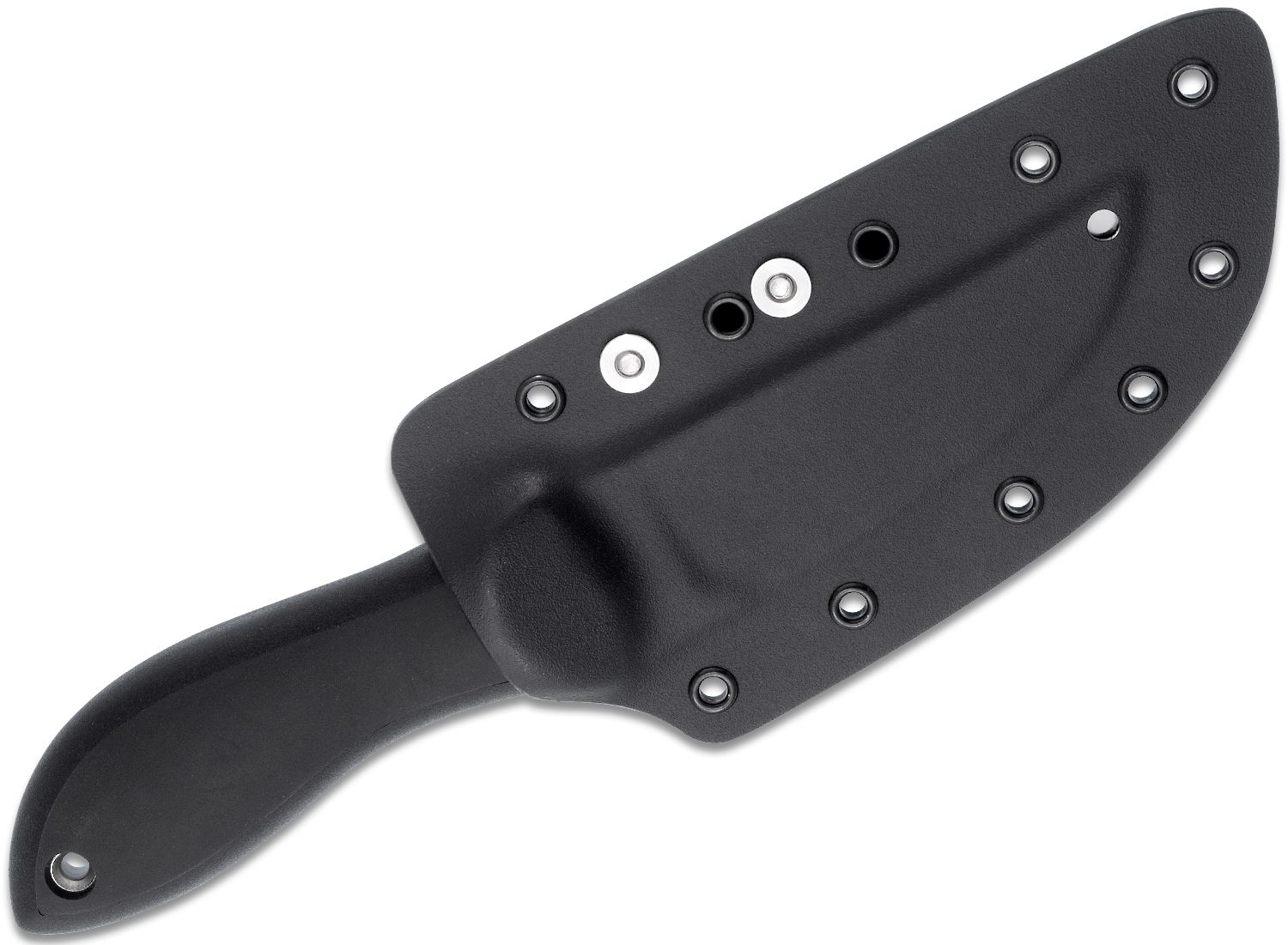
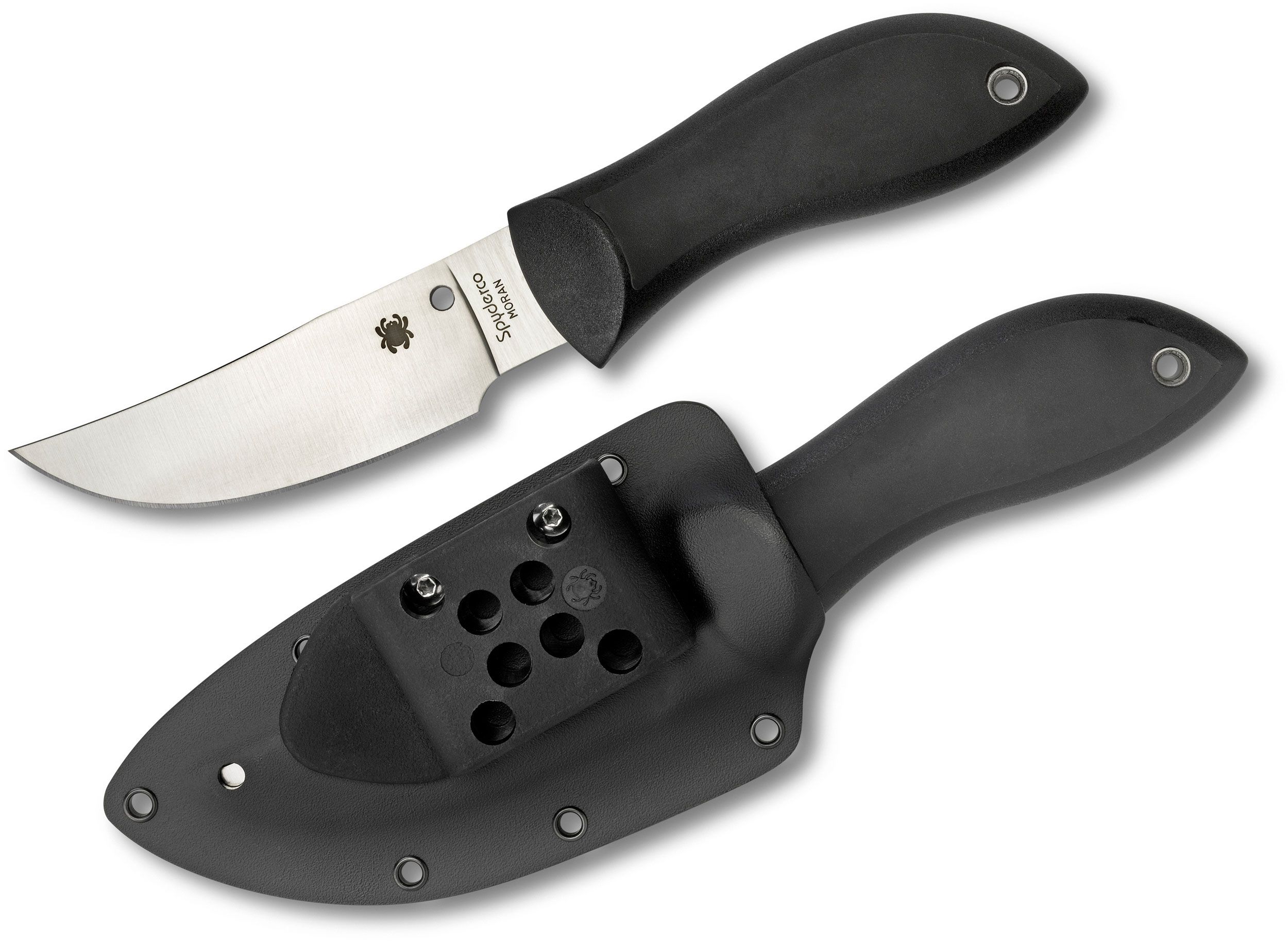
The FB01's handle was injection molded from tough fiberglass-reinforced nylon (FRN). Molded directly onto the blade's concealed tang, it was inlaid with panels of Kraton rubber to ensure an exceptionally secure, non-slip grip. In its original form, the FB01 came complete with a handcrafted leather belt sheath, but that sheath was later replaced by one custom molded from Concealex and ultimately Boltaron. Both of the latter sheaths featured a Blade-Tech Tek-Lok belt attachment.
In 2000, the FB01 was joined by the FB02—another expression of the Moran design featuring the same handle construction, but showcasing a drop-point blade profile and a conventionally sharpened edge. The names of both knives were also adjusted to include the terms “upswept” and “drop point” to reflect their respective blade shapes. Sometime later, a Trademark Round Hole was added to the blades as a proud symbol of the Spyderco brand.
Both Moran models quickly earned a devoted following among hunters and outdoor enthusiasts who appreciated their exceptional balance of light weight and full-service cutting performance. Around 2010, these qualities also attracted the attention of select U.S. military units, who approached Spyderco in search of a fixed-blade knife for use on their aircrew survival vests. After field testing several models, they ultimately chose the Moran Drop Point for official issue to their service members. To make it suitable for use in a SERE (Survival, Escape, Resistance, and Evasion) role, we produced the knife with a non-reflective titanium carbonitride (TiCN) blade coating and added a lined lanyard hole on the handle for attachment of a “dummy cord.” This feature was also incorporated into the handles of both satin-finished Moran models.
Prized for their outstanding cutting performance and edge retention, Bill Moran's Spyderco models also offer excellent corrosion resistance, deft balance, and superior control during use. For all those reasons, after nearly 30 years of service, they remain popular choices among discriminating hunters and outdoorsmen, as well as an enduring tribute to a true knifemaking legend.
EDGE-U-CATION
Getting to Know the G-Clip
In many ways, a fixed blade knife is only as good as its sheath. Besides protecting the knife and its owner when not in use, a well-designed sheath should also allow convenient, comfortable carry and quick, reliable access. And one of the keys to satisfying those requirements is proper mounting hardware.
The sheaths of Spyderco's early fixed-blade knives were equipped with either large or small Tek-Lok mounts. Designed and manufactured by Blade-Tech, these mounts were secure and offered quick attachment to most sizes of belts. They were also adjustable to allow vertical or horizontal carry. Their limitation, however, was that they only supported carry on a belt.
To provide greater versatility in the carry of our fixed blades, Spyderco looked to the late Mike Sastre. One of the pioneering masters of custom-molded Kydex sheaths, Sastre's work was well known in the knife community—especially among savvy tactical users. Although his meticulously crafted sheaths showcased everything from ball-chain neck carry to his uniquely old-school “Southern Comfort” system, Sastre's most popular designs featured his innovative J-Clip and G-Clip attachments.
Hand molded from thick Kydex, Sastre's J-Clip was designed for exceptionally discreet inside-the-waistband (IWB) carry and even worked with a tucked shirt. His original G-Clip allowed both belt carry and IWB carry and also provided a “tuckable” option for deep concealment. Because of its versatility, Spyderco chose to adopt the latter clip design, but with some modifications. Instead of placing the mounting holes at the tip of the G-Clip (necessary for tuckable carry), we placed them in the body of the clip. Spyderco used the same hole spacing as a small Tek-Lok to remain backward compatible with our older sheaths, but used a different hole pattern to allow vertical, horizontal, and canted carry. Although clearly inspired by Sastre's design, Spyderco's expression of the G-Clip is more compact and versatile. It's also injection molded from fiberglass-reinforced nylon (FRN) for ease of large-scale manufacturing.
Configuring the G-Clip
With few exceptions, Spyderco's injection-molded polymer sheaths and custom-molded Boltaron sheaths are designed to be symmetrical. This allows the G-Clip to be mounted to either side of the sheath to maximize its versatility and its compatibility with both left and right-handed users.
The G-Clip attaches to the sheath with two stainless steel Chicago screw sets and two rubber washers that provide clearance between the clip and the molded cavity of the sheath. The Chicago screw hardware uses M4 metric screws with T-10 Torx heads. To adjust the configuration of your sheath's carry, use a T-10 Torx driver to remove the Chicago screws, then remove the clip. Experiment with the mounting position and orientation of the G-Clip, rotating it as necessary to take full advantage of its hole pattern. When you have decided upon your preferred carry position, re-mount the clip by inserting the female sides of the Chicago screws through the sheath holes and placing the rubber washers over the ends. Position the G-Clip over the female sides of the Chicago screws and insert the Torx-head screws through the body of the clip to screw them in place. Then, test your configuration to make sure it suits your needs and preferences. If it does, we recommend removing the Torx screws and applying a drop of temporary thread-locking compound to the threads before final assembly. This will help keep the screws from loosening over time.
The G-Clip's design allows it to accommodate most belts up to 1.5 inches wide for traditional belt carry. By varying the mounting position and angle of the clip, you can easily configure your knife for vertical, horizontal, forward-cant, rearward-cant, and inverted carry. You can also fine-tune its position to present the knife edge forward or edge back for strong-side, crossdraw, or small-of-the-back belt carry positions.
If you don't wear a belt, the G-Clip also functions like a classic spring-steel clip—like the kind found on traditional “boot knife” sheaths. In this role, it enables you to clip it securely to your waistband for IWB carry. Depending upon your preferred carry position, the clip can be angled to cant the sheath for maximum comfort, concealability, and accessibility. If you typically wear a jacket or vest with an interior breast pocket, the G-Clip can also be configured for inverted (handle-down) carry and clipped to that pocket. In that position, it carries much like a handgun in a shoulder holster, but without the bulk and hassle of the harness.
Other Carry Options
Although the G-Clip provides a wide range of carry options, Spyderco understands it is not the solution for every problem. For that reason, they made it easily removeable and we purposely craft all their molded sheaths with metal eyelets. This style of construction allows the eyelet holes to be used with zip ties, parachute cord, or other improvised fasteners to mount your sheath to MOLLE platforms, packs, battle belts, vehicles, and other surfaces. The eyelets also work with ball chains and parachute cord for neck carry and “static cord” appendix carry inside the waistband.
When it comes to turnkey fixed blade carry solutions, the venerable G-Clip is one of the simplest, most versatile solutions you'll find. Like most things Spyderco, it not only offers practical functionality, but also reflects a fascinating history involving some of the knife industry's most innovative minds.



 (
(