How To Choose The Right Knife: An Ultimate Guide


Why Do You Need a Knife?
To find the right knife, think about the tasks you intend to use it for. Knives can serve various purposes—slicing, chopping, or carving, for example—and knives that excel at some tasks can struggle with others, so it’s important to choose the right tool for the job. Once you know what you want your knife to do well, you’re well on your way to finding the right knife for you.
Step 1: Fixed or Folding?
The first question you’ll need to answer is whether you need a fixed blade or a folder. So, what’s the difference?
Fixed Blade Knife:
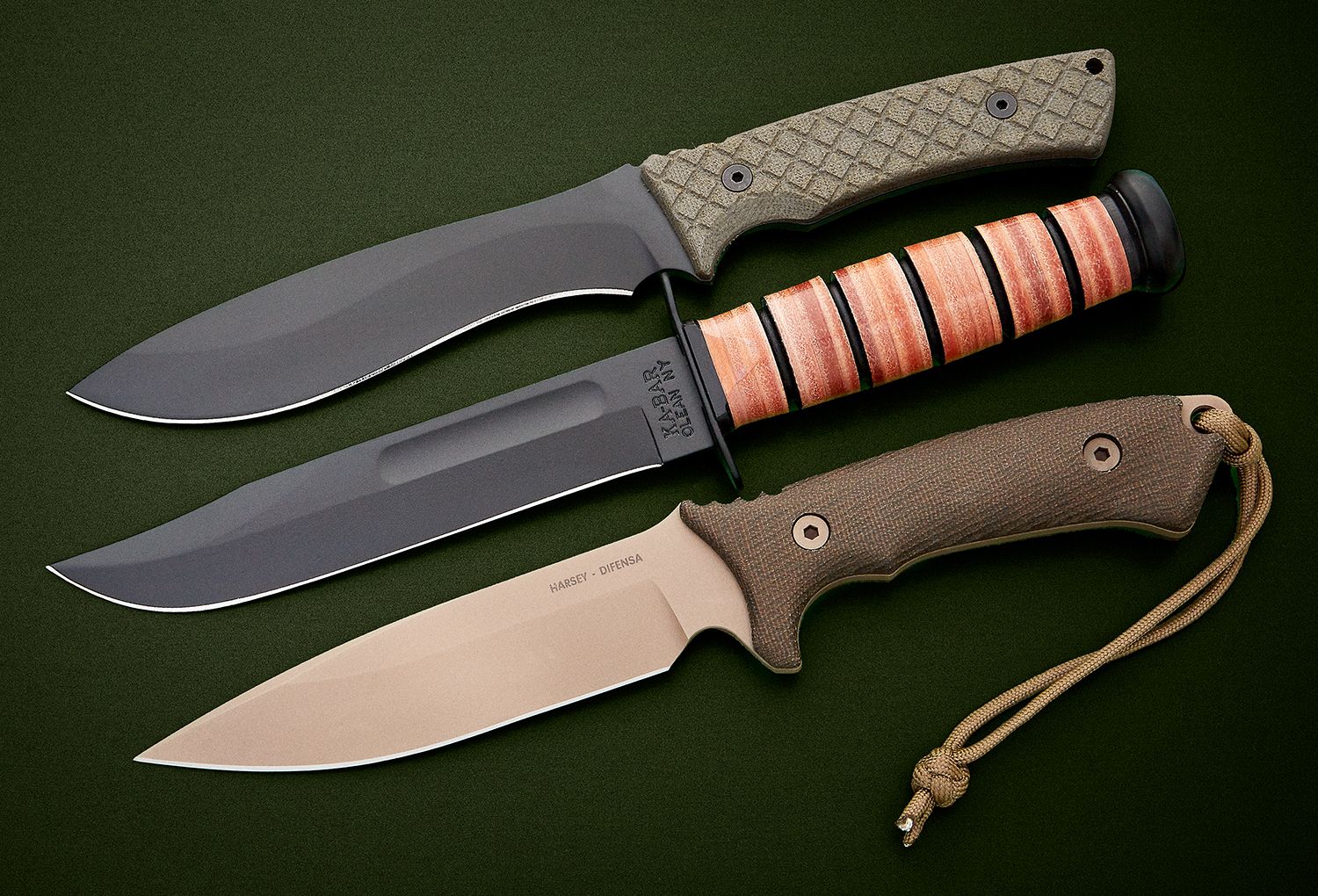
A fixed blade is a type of knife where the blade is integral with or attached to the handle and does not fold or retract. They are preferred for their robustness and simplicity compared to folding knives, making them suitable for heavy-duty tasks and unpredictable situations. Also, they tend to be more comfortable than folding knives because the handles can be shaped to fit in your hand, not in your pocket. Fixed blades require a sheath to hold and protect the blade while not in use.
Folding Knife:
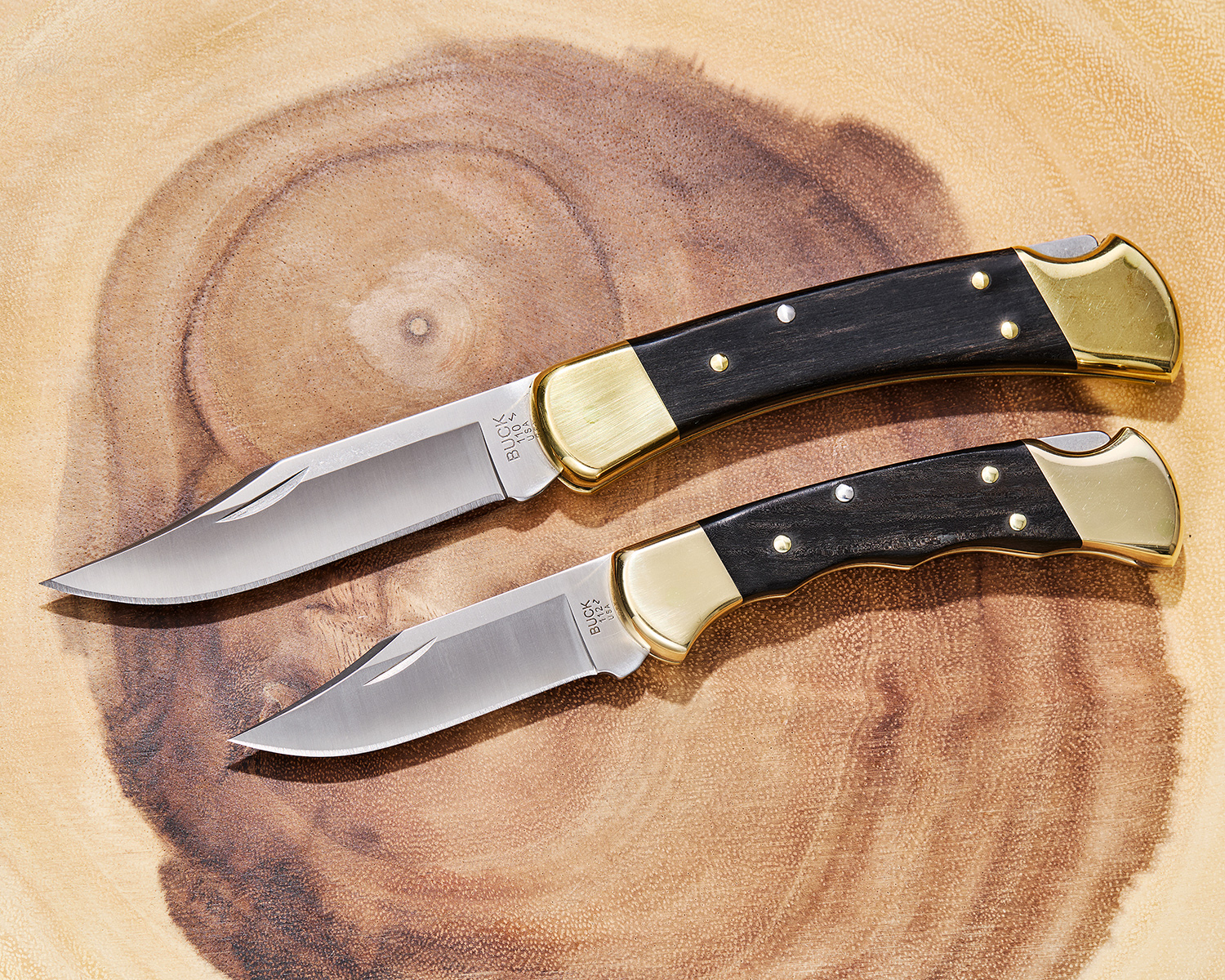
A folding knife, also known as a pocket knife, is a type of knife with a blade that folds or retracts into the handle. The folding mechanism allows the blade to be easily concealed and carried in a pocket or bag without the need for a sheath, hence the name “pocket knife.” Folding knives typically have a pivot point where the blade folds and unfolds, along with mechanisms such as locks or springs to secure the blade in both the open and closed positions. If you want to know more about knife locks? Consult our guide to folding knife lock types. While they may not be a strong or as comfortable as a fixed blade, you can’t beat the folding form factor for convenience!
Step 2: Find Your Type
- Pocket knife: Do you need something easy to carry for everyday tasks like opening boxes or cutting food?
- Outdoor/Survival: Do you need something tough that you can rely on when you’re adventuring away from home?
- Bushcraft: Are you interested in carving and crafting with wood?
- Hunting/Fishing: Will you be field dressing game or cleaning/filleting fish?
- Tactical: Are you interested in a knife for self defense?
- Custom: Are you passionate about craftsmanship and want something exceptional?
Step 3: Geometry Cuts
- Learn About Blade Grinds: Grinds such as hollow grind, flat grind, and convex impact cutting performance and blade strength. The thinner the edge, the better at slicing it will be; the thicker the edge, the stronger it will be. Consult our Ultimate Guide to Blade Grinds to learn more!
- Explore Different Blade Shapes: Different blade shapes like drop point, clip point, and tanto serve different purposes. For example, drop point blades are versatile for general tasks, clip point blades have a finer tip for easier piercing, and tanto blades tend to be thicker at the tip for brute strength. For a thorough explanation of these and all the other blade shapes, check out our Blade Shapes: Explained page.
Step 4: Material Choices
- Compare Blade Steels: Understanding the properties of different blade steels will allow you to make a smart decision for your budget, because every blade steel offers a unique balance between durability, edge retention, corrosion resistance, and price. To help you choose a blade material that aligns with the intended use of the knife, we’ve put together a guide to the best blade steels.
Step 5: Hand, Meet Handle
- Pick Out Your Handle Materials: Familiarize yourself with common handle materials like wood, G-10, and Micarta. Each material offers unique characteristics, but most of it comes down to personal taste. Feel free to try something new to find what works for you. Our guide to knife handle materials is the perfect reference to help get you pointed in the right direction.
Step 6: Maintain and Be Happy
- Review Our Sharpening Guide: Once you know how to sharpen, you’ll be able to keep all your edged tools in top form. There’s really no one best way to sharpen—whether you go freehand or use one of the many excellent guided sharpening systems out there, you can achieve incredible edges when you know how to apex properly. Our sharpening guide will help you achieve those hair-whittling edges!
- Learn Knife Care Guidelines: Familiarize yourself with proper knife care and maintenance practices to ensure longevity and optimal performance. This includes cleaning, lubricating pivot points (for folding knives), and storing the knife appropriately.
Step 7: Enjoy!
Now that you’ve found the right knife, there’s nothing to do but wait for it to arrive from knifecenter.com so you can put it to good use!
Frequently Asked Questions
What’s the best knife for a beginner?
For most beginners, a mid-size folding knife with a drop point blade is the ideal starting point. The drop point is the most versatile blade shape — the tip is strong enough for general tasks and the belly gives you plenty of slicing edge. Look for a blade around 3 inches, a proven lock, and a durable handle material that’s easy to grip in any conditions. You don’t need to spend a fortune: the $50–$100 range is genuinely excellent today, especially from brands like Kershaw, SRM, and CIVIVI.
What is MagnaCut, and do I need it?
MagnaCut is a blade steel developed by metallurgist Larrin Thomas and introduced in 2021. It’s designed to hit a balance of edge retention, toughness, and corrosion resistance that was previously impossible to achieve in a single steel — other high-performance steels force a tradeoff between at least two of those properties. MagnaCut doesn’t.
It has since become the new benchmark for premium knives, with dozens of brands adopting it across EDC folders, hunting fixed blades, and even automatic switchblades. You can now find MagnaCut knives for under $150, which would have been unusual even two years ago.
That said, you don’t need it. If you’re opening packages, cutting food, and doing light camp tasks, a well-heat-treated knife with conventional steel will serve you well (or even better in some cases). Choose MagnaCut when you want longer edge life or need your knife to survive exposure to wet or humid environments. Although it is a meaningful upgrade for most, it’s not a requirement.
What’s the difference between a frame lock and a liner lock?
Both are types of locking mechanisms that secure a folding knife’s blade open during use, and both work on the same principle: a spring-tensioned piece of metal moves behind the blade’s tang when it opens, preventing it from closing.
The difference is in the thickness of the lock bar and how the knife is constructed: a liner lock uses a thin strip of metal inside the handle, separate from the handle scales themselves. A frame lock uses a cutout in the handle itself (typically made from steel or titanium) as the locking bar, which removes the need for handle scales altogether. There’s no clear winner when it comes to strength or reliability, but frame locks are common on premium titanium-handled knives so they have a reputation for greater quality, while liner locks are more common at mid-range price points.
For more in-depth information about all kinds of knife lock mechanisms, consult our guide to Knife Lock Types.
Is a fixed blade or folder better for outdoor and survival use?
Fixed blades have the edge for demanding outdoor use. Because there’s no pivot, no lock, and no moving parts, a fixed blade is stronger, easier to clean, simpler to maintain, and more reliable under stress. A full-tang fixed blade — where the steel runs the full length of the handle — is especially well-suited to hard tasks like batoning, prying, or extended camp work.
That said, folders are far easier to carry and for most weekend camping and hiking they’re perfectly capable so long as you’re aware of their limitations. But if you’ll be in the backcountry for extended periods or expect to put your knife through genuinely hard use, a quality fixed blade is worth having along.
What blade length should I look for in an EDC knife?
For everyday carry, a blade between 2.75 and 3.5 inches covers the widest range of tasks without drawing unwanted attention or running into blade-length restrictions in most jurisdictions. Blades in this range are practical for opening packages, food prep, and light cutting while remaining comfortable in a pocket all day.
Going smaller gives you maximum discretion and makes the knife easier to carry in lighter clothing. Going larger gives you more slicing power and reach, which matters if you use the knife for food prep or self-defense, but the knife will be more noticeable in a pocket.
Always check your local laws — blade length restrictions vary significantly by city, county, and state, and some jurisdictions restrict lock types as well as length.
What does “out-the-front” (OTF) mean, and are they legal to carry?
An out-the-front knife is an automatic where the blade deploys tip-first straight “out the front” of the handle, rather than swinging out from the side. OTFs can be double-action (the same switch fires and retracts the blade) or single-action (the blade is fired by a button but retracted manually). Brands like Microtech have built their reputation almost entirely on OTF designs.
Legality is complicated. Federal law restricts the interstate sale of automatic knives, with exceptions for military, law enforcement, and a few other categories. State laws vary widely: some states permit all automatics freely, while others restrict blade length or prohibit them entirely. California, for instance, limits OTFs to blades under 2 inches in most situations. Before buying any automatic knife, verify the rules in your specific state and municipality.
How much should I spend on my first good knife?
The $50–$100 range is genuinely excellent for a first quality knife — better than it’s ever been. Chinese manufacturers have closed the quality gap significantly over the past decade, and you can get ball-bearing pivots, premium-feeling handle materials like G-10 or Micarta, and reliable lockup at this price point from brands like CIVIVI, SRM, CJRB and and many more.
At $100–$250, you move into more luxurious knives with noticeably better fit and finish, better steels (including MagnaCut), and tighter tolerances. This is where brands like Spyderco, Benchmade, and Zero Tolerance live, and where most enthusiasts find their long-term carry knives.
Above $250, you’re paying for premium steels, bespoke handle materials, tighter machining, and the prestige of brands like Chris Reeve Knives or custom makers. Excellent knives, but not necessary unless you know exactly what you’re optimizing for.
What’s the easiest way to sharpen a knife at home?
For most people, a simple guided or fixed angle sharpening system is the easiest way to keep your knives sharp at home. Systems that take the guesswork out of holding the correct edge angle help beginners from getting tripped up. In order of cost, we like the Lansky crock stick systems, the Spyderco Sharpmaker, and the Work Sharp Precision Adjust sharpeners.
If you want to go freehand on whetstones, it’s a more rewarding skill but takes longer to develop. Start with a medium grit (around 400–600) to set the edge, move to a fine grit (1000–2000) to refine it, and finish on a strop to finish the edge. The most important variable is consistency — a consistent angle across the whole stroke matters more than the equipment you use.
For harder steels such as S90V, diamond plates or diamond-coated rods will cut faster and more efficiently than ceramic. For softer steels, ceramic works well and can be more forgiving to use.
Have a question we didn’t answer? Browse our full library of knife buying guides and expert advice, or reach our team at 800.338.6799.