
 (
(Pros: None
Cons: Blade Material, Handle Material, Overall Quality
over priced
Poor Edge retention, overpriced.
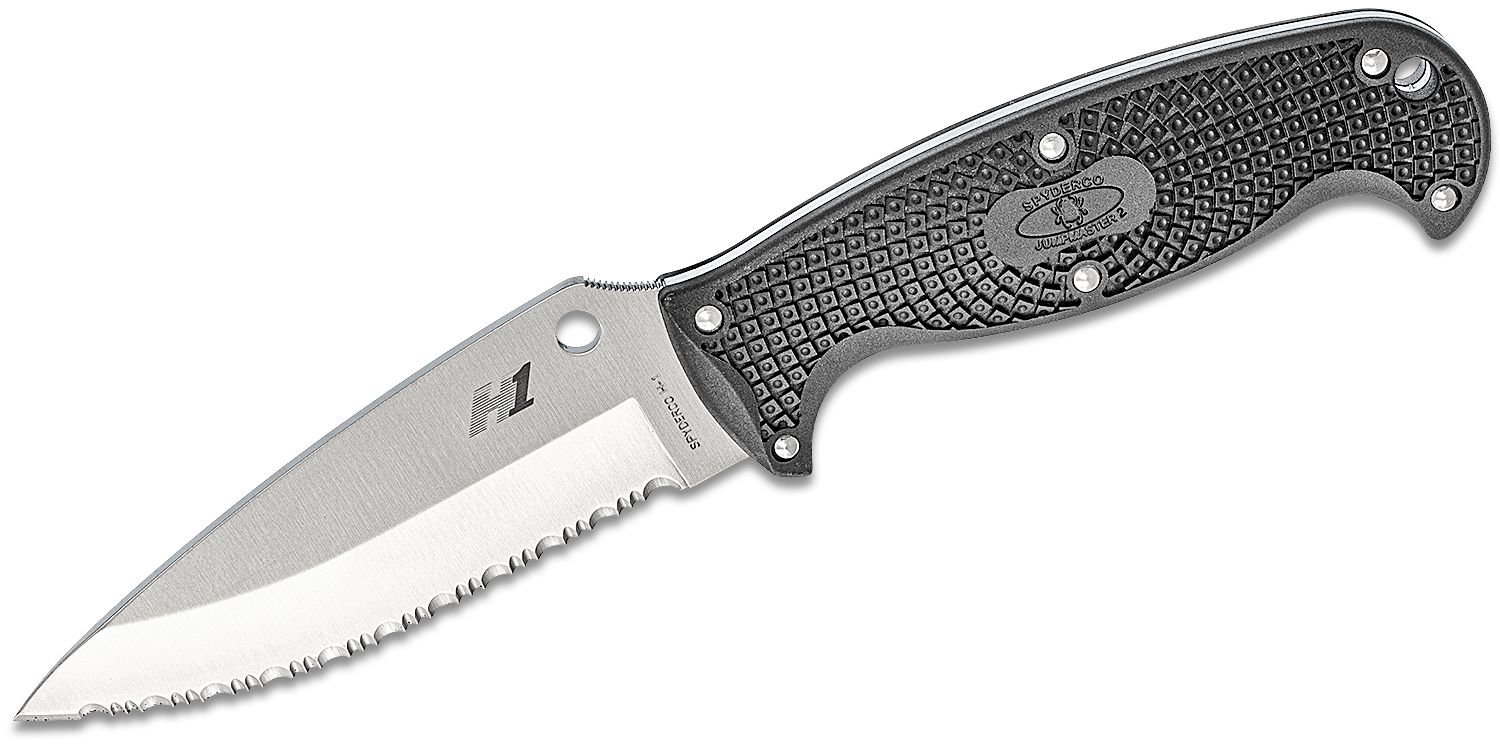
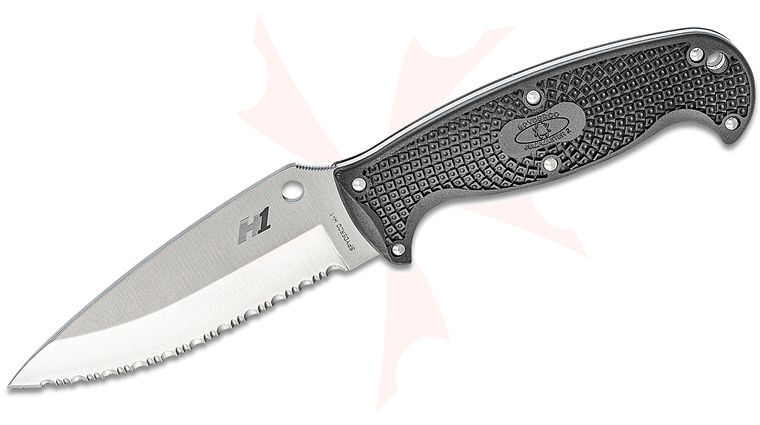
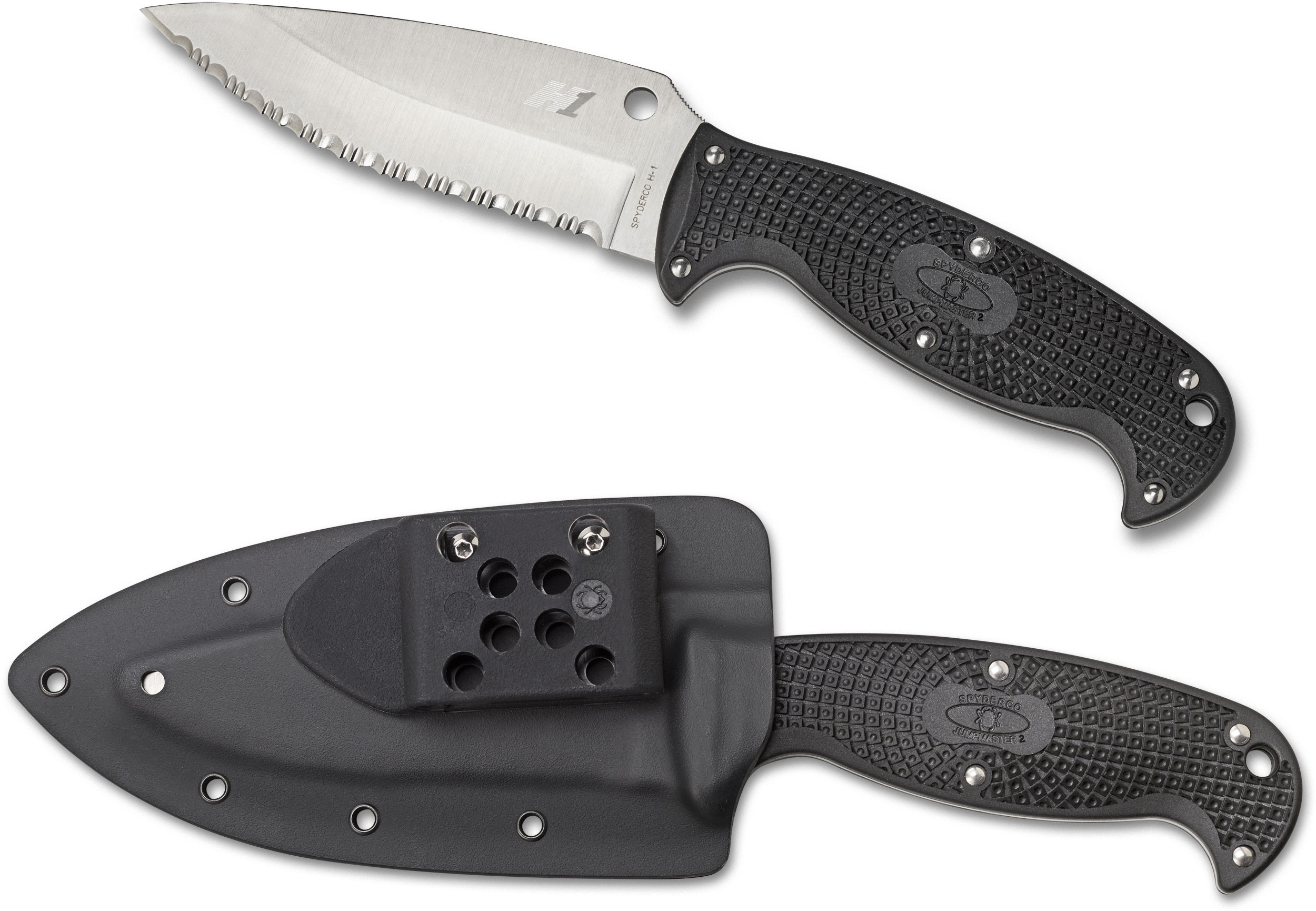
The Jumpmaster 2 is an extremely rugged and reliable fixed blade knife suitable for a wide range of cutting tasks. It also represents the latest chapter of one of the most unique product-development processes in Spyderco's history.
According to official Department of Defense terminology, a jumpmaster is "The assigned airborne-qualified individual who controls paratroops from the time they enter the aircraft until they exit." In broader terms, jumpmasters are the expert paratroopers in an airborne unit who train and teach the military techniques for jumping from airplanes. They also manage jump operations for Airborne units across all branches of service.
The most common form of military airborne operation is what's known as a "static line" jump. In this type of jump, a line made of heavy webbing known as a static line is attached to each paratrooper's parachute and to a cable inside the aircraft. When the paratrooper exits the aircraft, the static line unfolds until it hits the end of its length and is pulled taut, automatically opening the parachute.
One potential danger of this type of jump is that a parachutist might become tangled in his static line upon exiting the aircraft. Rather than deploying his parachute, the static line tows him behind the aircraft where he can potentially impact the fuselage and be knocked unconscious. When this occurs, the jumpmaster must act swiftly to cut the static line and free the jumper before he is injured so he can deploy his chute manually. To do that, the jumpmaster must have a knife that can be drawn in an instant and sever the heavy static line with a single cut. This challenge was the inspiration of the original Spyderco Jumpmaster knife.
The Origins of the Project
The Jumpmaster project began with an email from U.S. Army Major (now retired Colonel) Bryan Hernandez to Spyderco in January 2005. At that time, Hernandez was the Operations Officer for the 1st Battalion, 504th Parachute Infantry Regiment, 82nd Airborne Division at Ft. Bragg, North Carolina. In that role, he supervised all the jumpmasters of his regiment and was closely involved in all equipment selection related to their operational performance and readiness.
Hernandez' email outlined the critical need his jumpmasters had for a high-performance fixed blade knife and asked if Spyderco had any ready-made options that would satisfy it. It also piqued the interest of Spyderco co-founder, Sal Glesser, who personally contacted Major Hernandez to discuss his unit's needs. Since the jumpmasters' job performance could literally mean the difference between life and death, Sal was committed to designing and manufacturing the absolute best tool for the job.
Within a few weeks of his first conversation with Major Hernandez, Sal was on a plane to North Carolina to meet with Hernandez and his jumpmaster cadre. During that visit, he received a crash course in the duties and responsibilities of a jumpmaster, learned about their response procedures in the event of a towed parachutist, and developed an in-depth understanding of the performance criteria necessary for dedicated jumpmaster knife. He also observed a typical static-line airborne operation and toured Ft. Bragg's Special Operations museum and their extensive collection of military knives.
Design Requirements
Based on the input from Major Hernandez and the 82nd Airborne's jumpmasters, a purpose-designed jumpmaster knife needed to satisfy the following requirements:
Armed with these design parameters, Sal began the development process by considering the dynamics of a towed-parachutist situation. Suspended by a taut static cord, the paratrooper would be thrown about violently by the draft of the aircraft. Such erratic movement would make the use of a sharply pointed knife dangerous to all involved. Similarly, if a jumpmaster had to use the knife to cut a cord or strap in close proximity to a paratrooper's body prior to a jump, a pointed blade posed a hazard.
In 1982, the Spyderco Mariner pioneered the concept of the modern folding rescue knife by adding serrations to a traditional blunt-tipped sheepsfoot blade. The sheepsfoot profile had long been a standard for maritime use, providing a long, straight edge that cuts with impressive power and a blunt tip that will not puncture flotation gear. It is also a perfect choice for rescue work, enabling the user to safely slip the blade under the seatbelt of a trapped accident victim without fear of puncturing him. Adding Spyderco's signature SpyderEdge serration pattern to the blade further increased the linear cutting area of the edge and the blade’s ability to cut fibrous materials like webbing. For all these reasons, a generously sized, fixed blade, sheepsfoot-style knife was the logical choice for jumpmaster use.
The next design considerations were the handle shape and texture. A wide, relatively flat handle was chosen because it lies flat across the palm and enables the user to instinctively orient the cutting edge for accurate, powerful cuts. Sal designed the handle shape to naturally "bracket" the hand between the ricasso (the flat area of the blade nearest the handle) and the butt, locking it firmly in place for powerful pulling cuts with the edge. He opted for a full tang for strength, but skeletonized it to reduce the knife’s weight and provide a deft, lively balance. The handle design also placed the knuckles of user's hand directly in line with the edge to ensure quick, accurate, and powerful cuts.
From Plastic to Steel
Per Spyderco's usual development process, the Jumpmaster, originally known as the "Devil Jumpmaster," began as a full-scale hand-drawn sketch. That sketch was then translated to a CAD (computer-aided design) drawing that was used to laser cut parts for a Plexiglas model. The plastic model was then used to refine the in-hand ergonomics of the knife to get the "feel" right.
After Major Hernandez and his team blessed the plastic model and the overall concept of the knife, the next step was to render the design in steel. Typically, this would result in one or two working prototypes, but since the Jumpmaster was a special case, multiple prototypes were produced for testing by the 82nd Airborne's jumpmaster cadre. These prototypes were crafted from CPM S30V stainless steel and hafted with green G10 scales. Major Hernandez and his team immediately put them to work and were amazed at their cutting ability. The knives easily severed static line with a single cut and performed exactly as hoped. Their only minor criticism was that the corners of the G10 handles were a bit too square.
"Steeling" the Show
Although the prototypes' CPM S30V blades performed extremely well, around this time Spyderco was introducing a new steel that Sal believed would perform even better. Called H-1, it was an ultra-corrosion-resistant steel developed in Japan by Myodo Corporation. Available exclusively to Spyderco, H-2 was an austenitic steel that achieved its hardness primarily through the compressive forces of a cold-work rolling process. Although it was also subjected to heat-based precipitation hardening, unlike traditional martensitic steels, it was not hardened and tempered by conventional methods.
In PlainEdge knives, H-2 does not equal the edge retention of martensitic steels; however, in the fully serrated SpyderEdge blade of the Jumpmaster, it offered voracious cutting power and retained its edge very well. H-2 is also exceptionally tough and corrosion resistant, making it the perfect material for the Jumpmaster.
Grip and Sheath Design
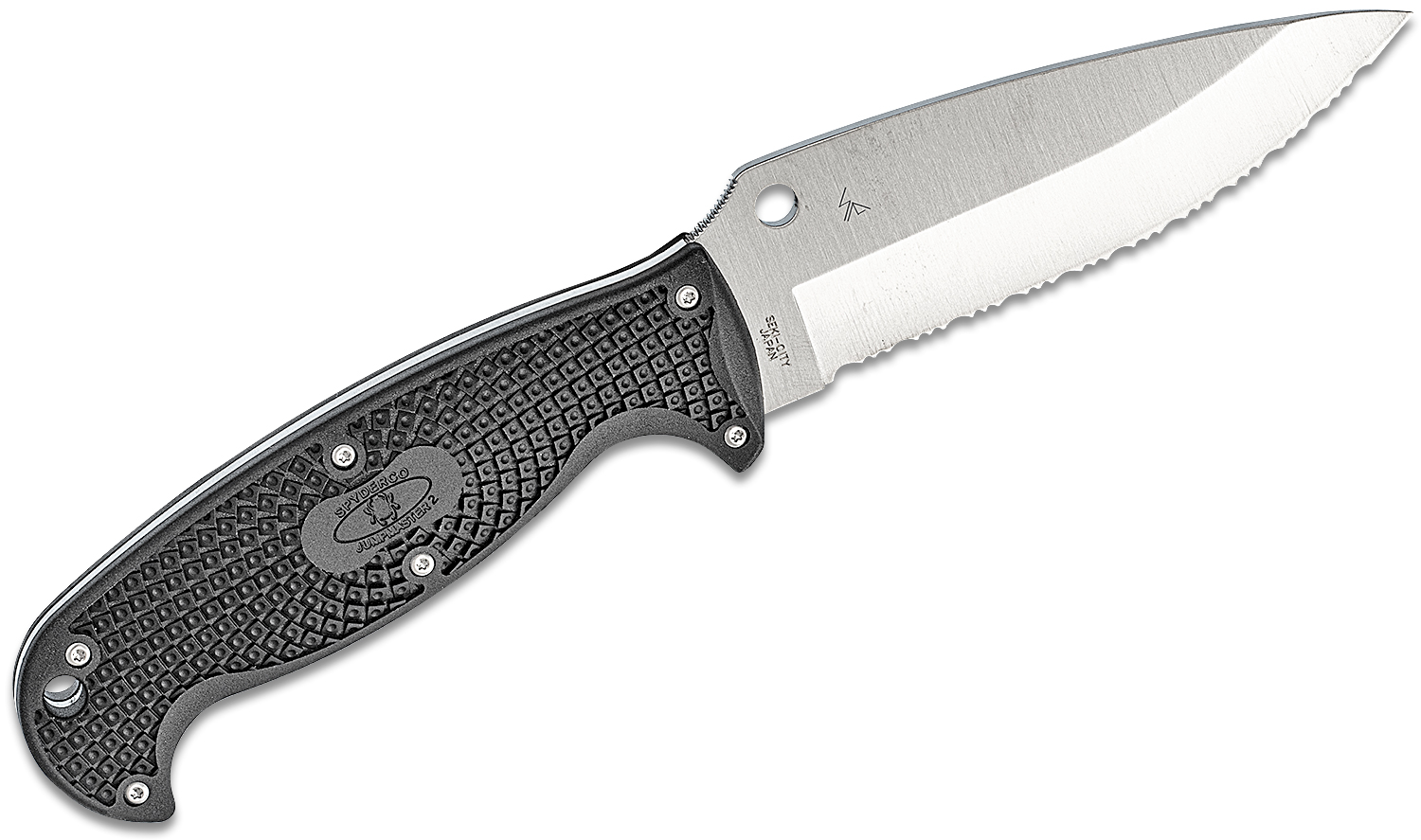
To address the concerns regarding the handle scales’ square corners, Sal decided to invest in the tooling for injection-molded fiberglass-reinforced-nylon (FRN) scales. This extremely durable material is lighter than G10 and immune to solvents and chemicals. It can also be molded in the fine detail required for Spyderco's signature Bi-Directional Texture pattern to achieve an ultra-secure grip during use. The molded scales were attached with multiple Torx screw sets machined from marine-grade stainless steel.
Per the requirements of the jumpmasters, the sheath for the original model was made from injection-molded polymer and specifically designed for mounting on the lower leg. The sheath allowed the knife to be inserted edge forward or edge back and locked it firmly in place with a snap fit. Dual nylon straps with Fastex buckles straddled the calf muscle for secure attachment and a concave surface on the back of the sheath contoured comfortably to the shape of the leg. This carry position allowed the knife to be quickly drawn with a straight pull and rapidly sheathed after use.
First-Generation Release
The Jumpmaster was officially unveiled at the 2009 SHOT Show and soon thereafter went into service with individual members of the 82nd Airborne jumpmasters. It also found favor with other airborne units and many savvy civilian knife users. Unfortunately, by that time, Major Hernandez had transferred to another duty post and was no longer able to personally drive the official adoption of the knife or the issuance of a National Stock Number (NSN).
Because of its specialized nature, the original Jumpmaster’s appeal to the broad civilian market was limited. However, once hardcore survivalists and "preppers" got a taste of the extreme cutting power of its long serrated edge, it developed a bit of a cult following. The members of that cult also began expressing interest in a version with a more conventional blade shape, a more utilitarian point, and a less specialized sheath. Taking that feedback to heart, Sal Glesser reimagined the design and created the Jumpmaster 2.
The Jumpmaster 2
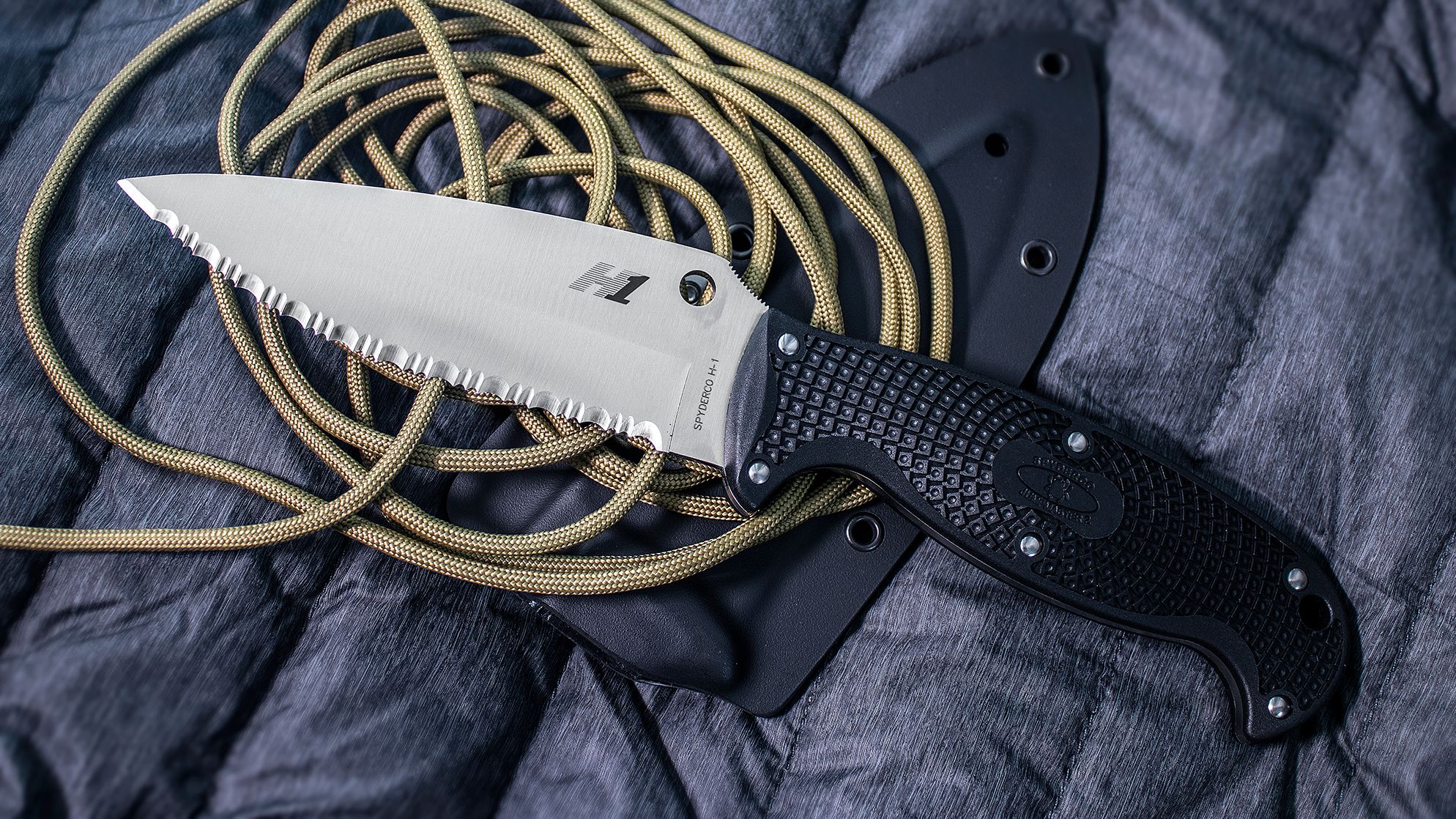
The Jumpmaster 2 faithfully retains all the key performance characteristics of the first-generation model, but expresses them with a leaf-shaped blade and an acute point profile. Its hollow-ground blade cuts with the same extreme authority as its predecessor and still offers remarkable edge retention, but with the added benefit of enhanced point utility.
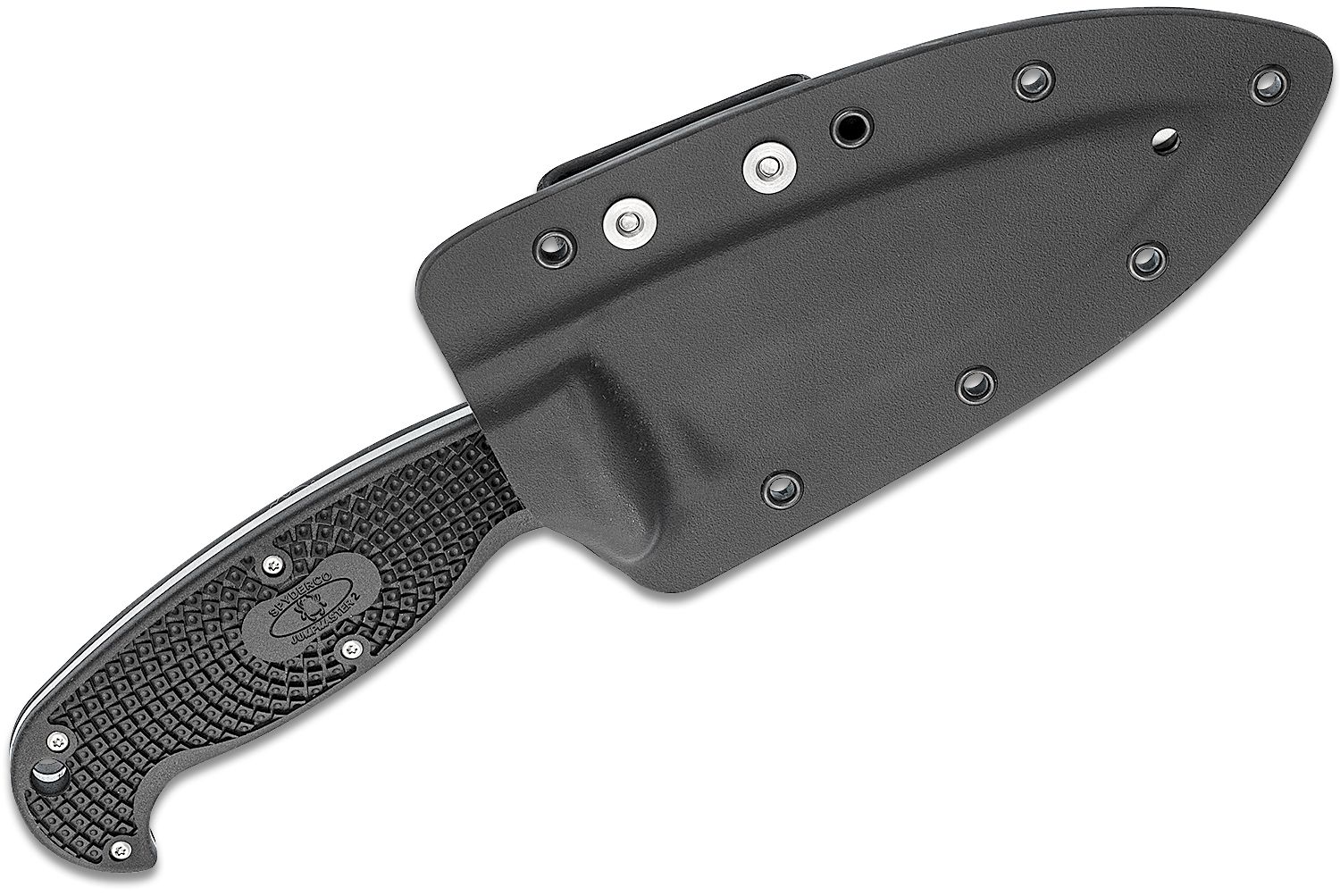
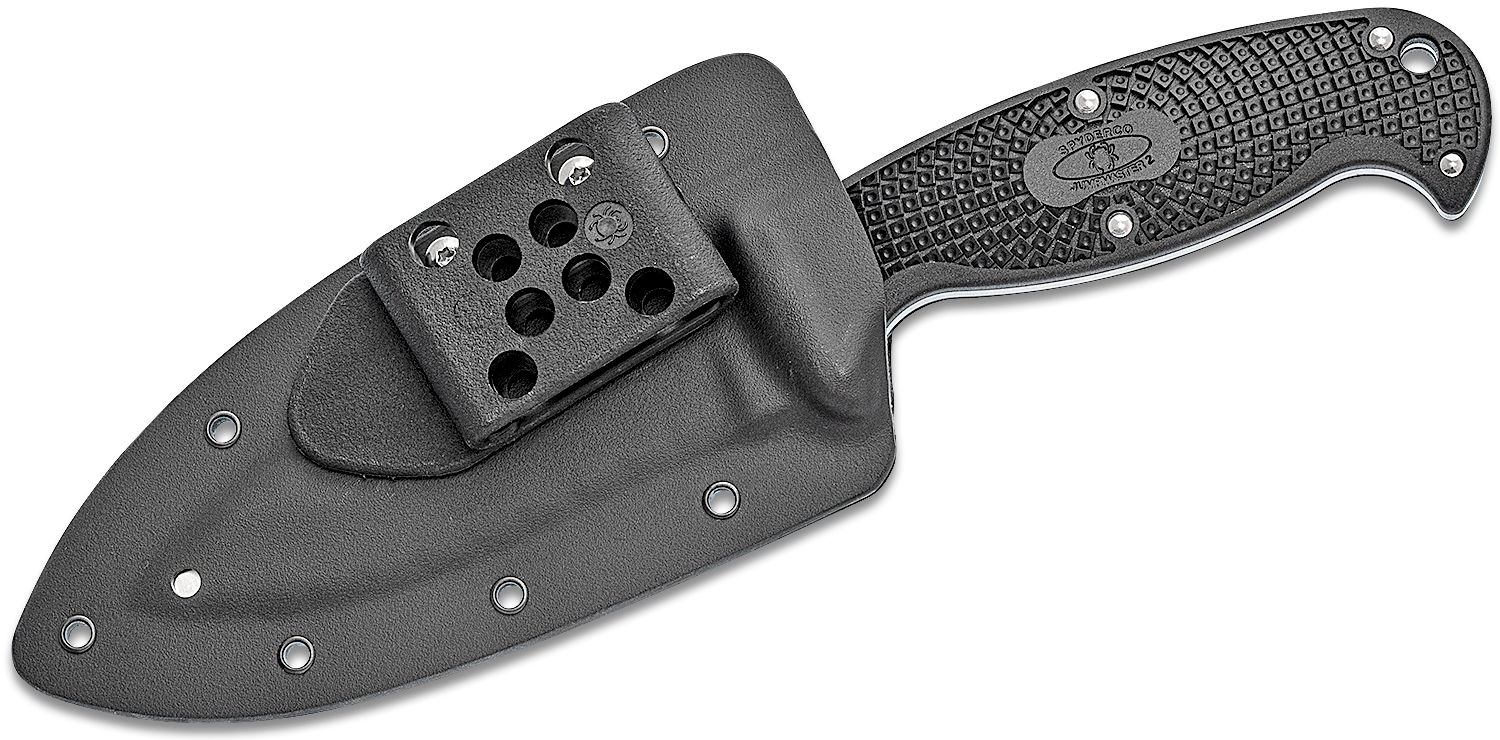
Introduced in the 2018 Spyderco Product Guide, the Jumpmaster 2 was initially crafted from H-1 steel and its handle featured brightly finished hardware. Later, its handle hardware was black coated to further enhance its corrosion resistance. To suit its broader scope of application, it rides in a custom-molded, snap-fit Boltaron sheath with a G-Clip attachment. The sheath’s symmetrical design allows the angle-adjustable G-Clip to be attached to either side, supporting a wide range of left or right-side carry positions. The two halves of the pancake-style sheath are also secured with eyelets that allow it to be easily lashed or flex-tied to military vests, load-bearing equipment, and other platforms.
Enter H-2
As the third largest steel producer in the world, Japan was particularly hard hit by the far-reaching effects of the COVID-19 pandemic. One of the consequences of the restructuring of its steel industry was the discontinuation of the production of H-1. Fortunately, through close cooperation with our manufacturing partners in Japan, Spyderco was able to drive the development of a new ultra-corrosion-resistant steel, appropriately named H-2.
Like H-1, H-2 is exclusive to Spyderco. It takes the time-tested alloy composition and manufacturing processes of H-1 and refines them even further. The result is a steel that retains all the extraordinary qualities of the original, while being readily manufacturable.
Although H-1 versions of the Jumpmaster 2 can still be found in the marketplace, all current production has been transitioned to H-2. Functionally, the two versions are indistinguishable and offer an outstanding combination of cutting performance, toughness, and extreme reliability. Like their predecessor, they also reflect a rich history of being born and bred specifically for the rigors of military use.
Spyderco Knives, H2 Blade Steel, Zytel Handle Material, Fixed Blade Knives, Fixed Blade Knives Utility, Made in Japan